.png?width=1500&height=398&name=CO_Corporate%20Logo%202021_4C_HOR_FNL-1%20(1).png)

How to Engage Hard-to-Reach CXOs: The New Growth Playbook
This blog is part of Chief Outsiders’ New Growth Imperative series, designed to help CEOs and leadership teams engage executive decision-makers at targeted strategic accounts by turning deep insights into compelling customer value.

What Is Marketing, Really? Why Founders and CEOs Must Lead the Most Misunderstood Function in the Business
Thu, Jul 9, 2026 — Executive Takeaways Marketing is a core enterprise capability, not a support function, and deserves the same CEO-level engagement as Finance and Operations. Without a unifying system, individually reasonable decisions accumulate into random acts of marketing. Modern tools make execution faster, but they don't create strategic clarity, so the gap between activity and alignment keeps widening. CEOs can't delegate marketing entirely. Leading it means ensuring insight, strategy, and execution stay connected. This blog is part of Chief Outsiders’ Marketing Leadership for CEOs series, an ongoing examination of the critical dimensions of Marketing (the capital “M” is intentional, as you’ll see) that every CEO needs to understand.

Marketing Leadership for CEOs: An Executive Guide to Growth
Mon, May 4, 2026 — Executive Takeaways At a certain scale, Marketing stops being a support function and becomes the company's growth system. Everyone has opinions about marketing, which means it rarely gets the disciplined oversight it actually requires. The CEO is uniquely positioned to set clear intent and hold the function accountable. As a connected system, Marketing drives alignment and focus. This blog is part of Chief Outsiders’ Marketing Leadership for CEOs series, an ongoing examination of the critical dimensions of Marketing (the capital “M” is intentional, as you’ll see) that every CEO needs to understand.

Product > Market Alignment: The True Sign of a Startup Unicorn?
Tue, Mar 29, 2016 — For those of us knee-deep in the startup world, we’re inundated by Unicorn noise – first their rise and more recently their fall (or, at least their right-sizing). Any number of factors have played into this trajectory: from FOMO venture capital activity that drove unsustainable valuations, to startup growth hacking techniques that indicate initial hyper-scaling, but often run out of steam - exposing the startup’s gap between product and promise.

Marketing…the big “M” and the little “m”
Mon, Feb 22, 2016 — When it comes to understanding the function of Marketing, there are often common words that enter the equation like “website”, “brochures”, or “sales collateral”. While these are tools that typically originate from the Marketing department, they only scratch the surface of what Marketing encompasses in total. A wise person once characterized the poorly understood function in the terms of “there is a big 'M' in Marketing and a little 'm'”. Wow, that is profound. So, what do we mean when we say the big “M” of Marketing?
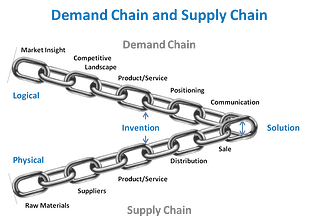
Growth Opportunity: The Demand Chain
Mon, Mar 19, 2012 — Efficiency Only Goes So Far The last ten years of American business have been focused on integrating and perfecting operational efficiencies through the perfection and active management of the Supply Chain. For the last couple of years of economic turmoil, many companies have almost exclusively focused on supply chain efficiencies as a strategy for survival. Now the challenge is taking the expertise and company culture focused on linear thinking and introspection of the supply chain and start growing again.