
When PE Firms Miss the Signals — And Pay for It at Exit
A few years ago, I joined a strong regional healthcare services platform to lead its commercial organization. The revenue targets were aggressive, and the plan to hit them was me.
Marketing capability was limited. The CRM had been poorly implemented, and few people used it. The sales team had good people who had never been properly enabled. Leadership had no plans to invest in talent or go-to-market infrastructure. They expected one hire to close the gap.
We closed many of those gaps, but it didn't happen because of the hire. It happened because we rebuilt the commercial function. We led a transformation that positioned the business for strong multi-channel organic growth, and I helped architect an acquisition that took the business national.
I've seen the same assumption more than once since. A single executive can't stand in for a commercial system. Someone has to build it. Treating commercial leadership as a single hire is one of the signals sponsors miss, and the cost usually shows up at exit, when the growth story has to hold up in diligence.
Six Signals Most Sponsors Miss
Across mid-market portfolio companies, a handful of conditions keep showing up before a revenue plateau becomes a real problem. They’re not hard to spot if you’re looking for them.
The one I see most is the misalignment between sales and marketing. I’ve watched it happen at two organizations I was part of: a healthcare services company, and a life-sciences organization. Different markets, same pattern. Marketing was generating activity. Sales was generating pipeline. Neither team could explain why the numbers weren’t connecting, because they were working from different definitions of success. Every quarter the conversation reset. The problem was never the people. It was the absence of a commercial system that held both functions accountable to the same outcome.
- Revenue growth has stalled despite the plan. The go-to-market strategy exists on paper, but no one is driving weekly commercial execution against it.
- Sales and marketing aren’t pulling in the same direction. Pipeline generation and conversion are disconnected, and marketing spend isn’t tied to revenue outcomes.
- Customer retention or expansion revenue is weak. Net revenue retention is below plan, churn is creeping up, and customer success isn’t integrated with sales.
- Pricing and packaging are leaving money on the table. Discounting is uncontrolled, or packaging hasn’t kept pace with the product or the market.
- A platform or add-on acquisition needs one go-to-market motion. Integration has exposed duplicate sales teams, overlapping territories, or inconsistent positioning.
- There’s no real commercial operating system. Forecasting is unreliable, CRM data can’t be trusted, and pipeline reviews don’t drive decisions.
None of these is a crisis on its own. Together, they form a pattern, and that pattern tells you the business needs a different kind of intervention than a hire.
Why a Full-Time Hire Doesn't Solve This
The instinct is understandable. When commercial performance is the issue, find someone who owns commercial performance.
But a full-time executive hired at this stage of the hold period faces a specific set of constraints. They need time to get oriented. They'll want to build their own team. They have their own methodology, and they'll take at least 60 to 90 days before they're making decisions that affect the business.
More importantly, what the business needs at this stage isn't a permanent leader. It's someone who can assess what's broken, build the system, train the team, and leave the business in better shape than they found it.
That's what fractional commercial leadership is designed to do.
What the Engagement Actually Looks Like
A fractional Chief Marketing Officer or fractional Chief Sales Officer doesn't come in to consult. They come in to build.
The first 30 days are diagnostic: understanding the commercial model, mapping where value is leaking, getting clear on what the business can actually execute. The next 30 days are about building the system: the ICP, the pipeline process, the messaging architecture, the metrics framework. The final phase is about embedding it, making sure the team can run what's been built after the engagement ends.
The goal isn't dependency. It's a commercial system that performs without the operator.
Here's what that looked like in a recently concluded engagement with a healthcare services platform. The diagnostic phase surfaced a structural gap: there were no formalized commercial processes or cadences, and the team had no enablement tools like messaging guides. That finding shaped the build phase. We implemented a sales process with clear stages and defined exit criteria for each one, then embedded it into the team's operating rhythm. Over the course of the engagement, funnel sufficiency improved by 50 percent.
The Question Sponsors Should Be Asking
Most sponsors come to fractional commercial leadership reactively, when something is clearly wrong and the clock is ticking.
The better question is when to bring it in proactively: at diligence, to validate the commercial model before the investment closes; in the first 100 days, when the growth thesis is being stress-tested against reality; or in the middle of the hold period, before a plateau becomes a trend.
The companies that get the most value from this model aren't the ones in trouble. They're the ones who treat commercial leadership the same way they treat financial or operational expertise. They deploy it when they need it instead of hiring full-time and hoping for the best.
If you're reading this and recognizing one of your portfolio companies in these signals, here is what I'd tell you directly. A playbook alone won't be the save. Neither will a framework, including the one linked below. They show you what good looks like, but they can't tell you what to do first in your company, with your team, in your market.
That takes pattern recognition and judgment paired with the framework: reading which signal matters most right now, sequencing the fixes, and knowing which conversations can't wait. A fractional CXO who has worked through these problems before brings that judgment and applies it alongside your leadership team, so the improvement holds long after the engagement ends.
Next Steps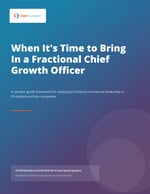
The PE Sponsor's Guide to Fractional Commercial Leadership provides a sponsor-grade framework for thinking through the decision: when fractional commercial leadership makes sense, how to match the model to the stage of the hold, how to structure the mandate, and how to justify it at the board level. If you’re heading into a portfolio review or a value creation conversation, it’s worth the read.
Topics: Business Growth Strategy, Value Creation, Private Equity

Related Articles