.png?width=1500&height=398&name=CO_Corporate%20Logo%202021_4C_HOR_FNL-1%20(1).png)


Vistage Chairs: The Most Dangerous Sales Answer a CEO Can Accept: “We Lost on Price”

When a Vistage member misses a revenue target, the explanation often begins with the sales team.
“We lost on price.”
“The competitor discounted aggressively.”
“The customer did not have the budget.”
“Our product was too expensive.”
Price may have influenced the decision. But when a CEO accepts “price” as the complete explanation, the company may lower prices, approve larger discounts, change its offering, or spend more money generating leads without understanding what actually caused the buyer to choose someone else.
That can be a very expensive mistake.
In many mid-market companies, the sales force serves as the primary source of market insight. The CRM contains a loss-reason field, the sales manager conducts a pipeline review, and the leadership team receives a summary of what happened.
The problem is that the salesperson often does not know the complete story.
The salesperson may never hear the conversations that take place inside the buyer’s organization after the final presentation. They may not know that the CFO questioned the expected return, the operations leader feared a difficult implementation, or the internal champion could not defend the recommendation.
The sales representative sees the outcome. The buyer understands the decision.
Why Salespeople May Genuinely Get the Answer Wrong
This is not an indictment of the sales force. Salespeople report what they know, and buyers do not always tell them the full story.
Price is a convenient explanation because it is impersonal. It allows the buyer to end the conversation without criticizing the salesperson, product, company, or proposal. It also preserves the relationship in case the buyer wants to revisit the supplier later.
Price can also become a comfortable explanation for the salesperson. It attributes the loss to something structural instead of raising more difficult questions:
- Did we pursue the wrong customer?
- Did we understand the buyer’s decision criteria?
- Did we establish enough differentiated value?
- Did we engage all the important stakeholders?
- Did we address implementation risk?
- Did we provide enough evidence to make the decision feel safe?
- Did the competitor tell a clearer and more persuasive story?
Over time, “price” becomes the default narrative. The CEO hears it repeatedly and concludes that the company must become more competitive by discounting.
But what if the buyer was willing to pay more and did not believe the additional value justified the difference?
What if the real concern was risk?
What if the winning competitor provided stronger proof, a clearer implementation plan, or a story that was easier for the buyer’s internal champion to explain?
A lower price will not solve any of those problems.
Price May Be the First Answer, But Not the Real Answer
One of the clearest studies of this problem comes from User Intuition, a provider of AI-moderated buyer research. The company analyzed 10,247 post-decision buyer interviews conducted between January 2024 and December 2025 across software, financial services, healthcare, manufacturing, and professional services.
Among 6,400 lost deals, buyers initially cited price or budget in 62.3% of cases. After researchers used a structured series of follow-up questions, price remained the primary decision driver in only 18.1% of cases.
The deeper issues included:
-
Implementation risk
-
Insufficient confidence among the buyer’s internal champion
-
Anxiety about how quickly the investment would produce value
-
A competitor’s simpler and more persuasive story
- Insufficient evidence from similar customers or industries
- The gap grew with deal size. In deals above $1 million, 68.4% of buyers initially cited price, while researchers classified price as the primary driver in only 9.7% of the losses.
The research has limitations. User Intuition sells buyer-research services, its findings have not been independently replicated, and post-decision interviews require researchers to interpret complex buyer motivations. The company also acknowledges that price may remain a contributing factor even when it is not the primary driver.
Still, the size and consistency of the gap provide a powerful warning. When a buyer says “price,” the CEO should hear “keep asking.”
Established Research Shows Buyers Evaluate Much More Than Price
Bain & Company reached a related conclusion after examining quantitative and qualitative B2B customer research conducted over three decades.
Bain identified 40 elements of value that influence business purchases. Price, specifications, regulatory compliance, and acceptable performance matter, but Bain describes these factors as table stakes. They qualify a supplier to compete, but they do not necessarily determine who wins.
Buyers also consider whether a supplier can:
- Reduce risk
- Simplify implementation
- Provide credible expertise
- Make the relationship easier to manage
- Reduce the buyer’s anxiety
- Protect or enhance the buyer’s professional professional reputation
- Demonstrate that the promised results can be delivered
This leads to an important distinction for CEOs:
Price may determine whether a supplier qualifies for consideration. The buyer’s perception of value, risk, and confidence often determines which qualified supplier wins.
When a buyer says a proposal was too expensive, the buyer may actually mean:
- “I could not see enough additional value.”
- “I was not confident that implementation would succeed.”
- “The expected return took too long to explain.”
- “Your competitor felt like the safer decision.”
- “I did not have enough evidence to defend your recommendation internally.”
- “Your proposal made the decision harder than it needed to be.”
Those are value, confidence, and risk problems expressed in the language of price.
Current Buyer Research Points to Confidence and Experience
McKinsey’s 2026 Global B2B Pulse surveyed nearly 4,000 decision makers across 13 countries.
The leading reason buyers gave for switching suppliers was inconsistent information across the supplier’s teams. Difficulty accessing knowledgeable representatives ranked second, followed by gaps in tracking the customer across channels. Price did not emerge as the dominant switching issue.
McKinsey also found that 53% of respondents belonged to a relationship-oriented buyer group that values trust, familiarity, and proven ways of working. Other buyer segments placed a premium on speed, transparency, tailored recommendations, digital sophistication, and a buying process without unnecessary friction.
This does not mean companies can ignore price. It means competitive pricing cannot compensate for an unclear value proposition, inconsistent information, limited expertise, a difficult buying experience, or unresolved risk.
A company can offer the lowest price and still lose if the buyer does not trust the outcome.
The Seller’s View of Value May Differ From the Buyer’s
Another reason sales feedback can lead a CEO astray is the gap between the value the seller believes it communicated and the value the buyer actually understood.
Gartner reports that sales cycles slow when gaps exist between how buyers discover and realize value and how sellers position the value of their solutions. Gartner recommends that sales organizations help customers discover, frame, affirm, and realize value throughout the buying process.
That distinction matters.
A sales team may believe it presented a compelling return on investment. The buyer may have seen generalized claims without enough evidence.
The sales team may believe the company’s experience reduced implementation risk. The buyer may not have seen a detailed plan or relevant customer example.
The sales team may believe its solution was clearly differentiated. The buyer may have perceived several vendors as largely interchangeable.
When the value difference is unclear, the price difference becomes more important.
The issue may not be that the company costs too much. The issue may be that the company failed to make the additional value understandable, credible, and defensible.
CRM Loss Reasons Are Not Buyer Intelligence
A CRM system can tell the CEO which deals closed and which ones did not. It cannot reliably explain why.
Most CRM loss-reason fields compress a complicated decision into one category:
-
Price
-
Competitor
-
Budget
-
Timing
- Missing feature
- No decision
- The buyer’s actual decision may involve several of these factors. It may also involve internal politics, confidence in the salesperson, the quality of the proposal, implementation concerns, or whether the initiative felt important enough to prioritize.
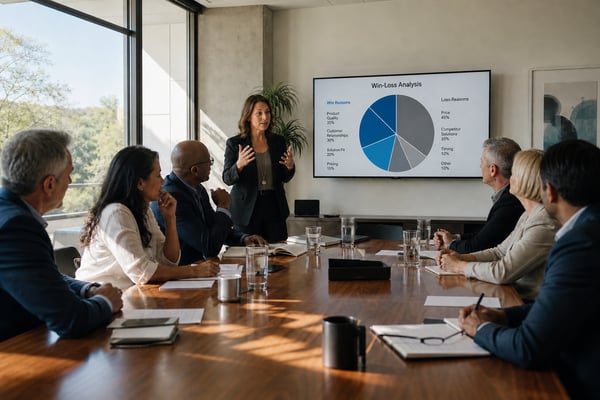
Gartner recognizes win/loss analysis as a formal discipline for minimizing internal bias, developing deeper insight into why deals were won or lost, and uncovering purchasing decision drivers that can lead to improved win rates.
The critical phrase is “minimizing internal bias.”
Sales reports are useful, but they reflect the sales organization’s view of the decision. Win/loss analysis adds the buyer’s view.
Companies Report Measurable Benefits From Win/Loss Analysis
In Clozd’s vendor-sponsored 2025 industry survey, 63% of respondents reported increased win rates from win/loss analysis. Among organizations that had operated their programs for more than two years, that figure rose to 84%.
The same survey found that companies using an independent third party were more than twice as likely to report satisfaction with the quality and depth of their feedback, 70% compared with 34% among companies managing the process internally.
These are self-reported results from a company that provides win/loss services. They should not be treated as independent proof that win/loss analysis alone produced the improvement. They do, however, show that many companies see measurable value when they investigate buying decisions systematically.
The economics can be substantial.
Consider a company with $20 million in qualified pipeline and a 25% win rate. That pipeline currently generates $5 million in revenue.
If better buyer insight helps the company increase its win rate to 30%, it produces another $1 million from the same pipeline. At a 35% win rate, the increase reaches $2 million.
The company does not need more leads to produce that revenue. It needs to learn more from the opportunities it already has.
What an Independent Buyer Interview Can Reveal
A good win/loss interview moves beyond “Why didn’t you choose us?” It reconstructs the decision:
- What first caused the company to consider making a change?
- Which alternatives entered the evaluation?
- What criteria mattered most?
- Who influenced the final decision?
- When did the buyer begin preferring one option?
- What created confidence?
- What created concern?
- How did the company compare with the winning competitor?
- What could the company have done differently?
- What did “too expensive” actually mean?
The last question deserves particular attention.
Was the price outside the approved budget? Was the competitor genuinely less expensive? Did the buyer calculate a weaker return? Did implementation uncertainty make the investment feel riskier? Or did the company fail to communicate enough differentiated value?
Each answer requires a different executive decision.
Questions Vistage Chairs Can Ask
When a member says, “We keep losing on price,” a Chair can move the conversation from assumption to evidence:
- Who says price is the reason, the buyer or the salesperson?
- How often does someone outside the sales team interview lost prospects?
- What evidence shows that the buyer understood the value of the difference in price?
- Did the buyer question the price or the expected return?
- What concerns did the buyer have about implementation and time to value?
- Did the internal champion have enough evidence to defend the decision?
- What did the winning competitor do that created greater confidence?
- What would a five-percentage-point improvement in win rate mean for revenue and gross profit?
A Chair does not need to assume the sales team is wrong. The Chair needs to help the CEO determine whether the company has enough evidence to know.
The Costliest Response May Be Another Discount
Price matters. In some deals, it will be the deciding factor. But a CEO should not reduce prices, alter packaging, or change strategy based on a CRM category and an internal opinion.
The CEO needs to determine whether the company truly lost because it cost too much or because the buyer did not understand, believe, or trust the value being offered.
Every lost deal contains information the company has already paid to acquire through marketing investment, sales time, demonstrations, proposals, and executive attention. When the leadership team accepts “price” without further investigation, it leaves that information behind.
Before approving another discount, ask the buyer what really happened.
Help Your Members Discover What Is Really Costing Them Revenue
If you have a member who keeps hearing “we lost on price,” is experiencing declining win rates, or cannot confidently explain why competitors are winning, Chief Outsiders can help replace internal assumptions with direct buyer evidence.
Our Win/Loss Analysis brings an objective, independent perspective to recent wins, losses, and no-decisions. We interview buyers to uncover:
- How they perceived the company’s value and differentiation
- Which competitors they considered and why
- Where the sales process created confidence or concern
- Whether price was the real issue or a proxy for risk, unclear value, or insufficient proof
- What the company must change to improve future win rates
We then translate the findings into a clear path forward, identifying the most important changes to positioning, messaging, pricing, sales execution, customer experience, and the company’s go-to-market strategy.
A small improvement in win rate can unlock substantial revenue from the pipeline your member already has. Before they spend more to generate leads, add salespeople, or approve deeper discounts, help them understand why they are losing opportunities they have already paid to create.
Call Karen Hayward at 650-823-4292 to discuss a member who could benefit from a Win/Loss Analysis. Together, we can help them hear what buyers are really saying and turn that insight into a focused 90-day plan for stronger win rates and more profitable growth.

Topics: Business Growth Strategy, Sales Strategy, CEO Networking: Vistage, CEO Business Strategy, Vistage
/cmo-Karen-Hayward.jpg?width=200&height=200&name=cmo-Karen-Hayward.jpg)
Related Articles