.png?width=1500&height=398&name=CO_Corporate%20Logo%202021_4C_HOR_FNL-1%20(1).png)


Vistage Chairs: There's One Buyer Conversation Your CEOs Aren't Having
How Win/Loss Analysis Gives Your CEOs the Buyer Feedback They're Not Getting
 After more than a decade as a Vistage member and hundreds of CEO conversations, one pattern keeps surfacing: most leaders believe they understand why they win business — and why they lose it. As a Vistage Chair, you spend countless hours helping your CEOs challenge assumptions, uncover blind spots, and see around corners. But there's a source of strategic insight that almost never makes it into the room: the voice of the buyer.
Deals are lost. Explanations are offered. The prospect chose a competitor because of price. They needed a feature we don't have. They already had a relationship with another vendor. These narratives feel plausible. They rarely tell the full story.
According to Gartner, 67% of lost deals are attributable to fixable issues — and 40% of sales teams misdiagnose why they lose. Meanwhile, Forrester Research finds that 80% of buyers are willing to share candid feedback. They just aren't being asked by the right people, in the right way.
That gap — between what sales teams report and what buyers actually experienced — is one of the most expensive blind spots in business.
The Feedback Gap
In most organizations, the sales team is the primary feedback loop to leadership. But buyers often tell salespeople what is easiest to say, not what would be most helpful to hear. There is too much relationship on the line, too much awkwardness to risk.
So the real reasons stay hidden. And leadership makes decisions based on incomplete data.
This is where Chairs can create enormous value — not by becoming a sales and marketing expert in the room, but by surfacing the right questions:
"When did you last have a structured conversation with a buyer who chose someone else?"
"How confident are you that your sales team's explanation of that loss reflects what the buyer actually experienced?"
"What would you do differently if you knew the real reason?"
Most CEOs pause when they hear those questions. They know the answer. They just haven't been pushed to confront it.
The Solution: Independent Buyer Interviews
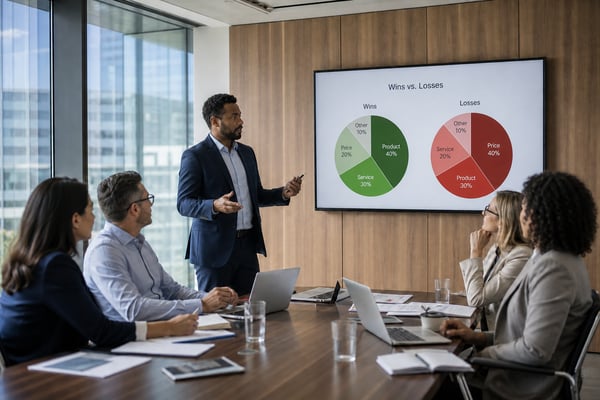
A structured win/loss program uses independent, third-party interviews to gather candid feedback from customers, prospects, and buyers. Because the interviewer has no stake in the outcome, buyers are far more forthcoming than they would ever be with a salesperson.
The insights that emerge are often eye-opening:
- Losses that were blamed on price were actually driven by perceived implementation risk
- Products leadership believed were differentiated were viewed as commodities by buyers
- Messaging executives loved internally never resonated with the people it was meant to reach
These are not edge cases. They are patterns — and they are costing companies real revenue.
A Real-World Example
When a major competitor entered the market, one cybersecurity company's leadership assumed aggressive price reductions were necessary to stay competitive. Independent buyer interviews told a different story: customers loved the product and were willing to pay the premium. Their real concern was whether the company could compete against a larger player.
The solution wasn't discounting. It was strengthening buyer confidence through better messaging and customer proof. The company preserved its margins and improved win rates.
That is the kind of insight that only surfaces when buyers have a safe, independent channel to be honest.
The Financial Case
Win/loss analysis typically delivers a 5–15% improvement in win rates — with some companies reporting 30%+ gains. Moving from a 25% to a 35% win rate on a $20M pipeline produces $2M in incremental revenue. With $0 in additional marketing spend.
Every lost deal contains a lesson. Every won deal contains a clue. CEOs who systematically capture and act on those insights gain an advantage competitors overlook.
A Practical Resource for Chairs
To help you bring this conversation to your members, I've put together a comprehensive Win/Loss Analysis Briefing that includes benchmark data, ROI examples, case studies, and practical implementation guidance you can review directly with your CEOs.
For a quick reference, download the Win/Loss Analysis Briefing or reach out to me directly — I'm happy to walk through it with you.
Because in this market, guessing why you lose is no longer a viable strategy.

Topics: Business Growth Strategy, CEO Networking: Vistage, CEO Business Strategy, Vistage
/cmo-Karen-Hayward.jpg?width=200&height=200&name=cmo-Karen-Hayward.jpg)
Related Articles