.png?width=1500&height=398&name=CO_Corporate%20Logo%202021_4C_HOR_FNL-1%20(1).png)

The Contrarian Brand Play: Why Right Now Is the Best Time to Invest in Brand
Part 4 of our four-part series on the evolving AI search landscape and what B2B leaders need to know to stay competitive.

A New Model of Leadership for the 21st Century
Fri, Jul 13, 2018 — The role science is playing in transforming leadership skills is profound. Recent neuroscience research is becoming key in transforming much of what we thought we knew about leadership. Insights gained are dramatically changing the way companies deal with the accelerated pace of change, changing nature of work, generational differences, demands for organizational performance and how we deal with performance issues and performance management systems.

CEO Shares How He Grew His Stained Glass Business with the Help of His Peer Advisory Group
Thu, Aug 17, 2017 — Business increased by 300% since joining Vistage Chief Outsiders Fractional CMO, Neil Anderson, has a conversation with Vistage Member and CEO of Scottish Stained Glass, Martin Faith, about his experience with Vistage, an executive coaching organization that provides leadership training and business coaching to CEOs and Executives.

CEO Shares the Benefits of Participating in a Peer Advisory Group
Mon, Apr 24, 2017 — CEO Experiences Growth from Being a Member of Vistage Chief Outsiders Fractional CMO, Neil Anderson, has a conversation with Vistage Member and CEO of TalenTrust, Kathleen Quinn Votaw, about her experience with Vistage, an executive coaching organization that provides leadership training and business coaching to CEOs and Executives.
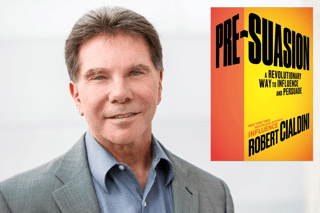
A Conversation with Robert Cialdini, Author of "Pre-Suasion, A Revolutionary Way To Influence And Persuade"
Tue, Apr 4, 2017 — At our recent National Meeting, Chief Outsiders hosted a dynamic Skype conversation with Dr. Robert Cialdini on his latest book Pre-Suasion, A Revolutionary Way To Influence And Persuade. The discussion not only further clarified not only Cialdini’s Pre-Suasion principles, but also provided insight into their applications to our clients’ and our specific business as well.

Top 12 (Plus 1) Leadership Skills I Learned from Boy Scouts
Tue, Feb 2, 2016 — Robert Fulgrum reminded us that “All I Really Needed to Know I Learned in Kindergarten” when he published his book of the same name. We’re told that if we: Share Everything Play Fair Don’t Hit People… …along with 13 more basic principles we will surely have a successful life. Well, he didn’t exactly say that, but certainly he asserts our lives would be more peaceful and our society less caustic.

What Giraffes can Teach You about Building a Strategic Growth Plan
Thu, Jul 23, 2015 — A funny thing happened as animal beings evolved over the past several billion years – one such beast was bestowed with the ability to get a bird’s eye view of all it surveyed – while staying firmly planted on the ground. The giraffe can grow up to 18 feet high, with nearly half of that height accounted for with a neck and head. The giraffe, rightfully so, is often chosen symbolize taking in the big picture, communication and gracefulness. This, my friends, is why you will understand when I say you need to roadmap like a GIRAFFE – visualizing your organization from a broad view before fabricating the details of its long-term strategic direction.

Your 2020 Vision Is Now A Five-Year Plan
Wed, Jun 24, 2015 — For those who have been disciples of futurist Arthur C. Clarke, it’s quaint to look back at his prescient interviews of a half-century ago, and try to imagine how he could possibly pinpoint conventions like the internet, instant messaging and even the way we as a society would interact. Even just two decades ago, the year 2020 still seemed a destination so distant, that it was difficult for many to bring into focus a realistic vision of what it could be. But author John Kotter, in his 1996 book, Leading Change, said, “The rate of change is not going to slow down anytime soon. If anything, competition in most industries will probably speed up even more in the next few decades."

Outstanding CEOs Often Play It By Ear
Wed, Oct 16, 2013 — I did not like the Beatles when they first came to America, but I am a contrarian by nature. Today, John Lennon and Paul McCartney are music icons that created a legacy of sound and lyrics. The Beatles created some of the most recognized and memorable songs of today. "I don’t read music, you got a problem with that?" - said Paul McCartney. They created music from what came into their minds. How did they do this and become world renown? I suggest to you they “played it by ear.”

Transforming an Organization: The 4 Steps Every CEO Should Take
Sun, Sep 15, 2013 — Companies can no longer settle for incremental improvement in today’s rapidly evolving and increasingly global economy—organizational transformation is necessary. McKinsey Quarterly, in their June 2011 issue offered the suggestion that in order to sustain high performance, organizations today must build the capacity to learn and keep changing over time and suggested that organizational health was perhaps the ultimate competitive advantage for today's economy. I can not stress more strongly how important the role of the CEO is in visibly participating in transforming an organization and how the CMO can assist in this process. I believe there is no single model for success, and actions will be influenced by the magnitude, need and nature of the change for an organization. But, in my experience there are four steps every CEO should take to transofrm an organization. I've found these basic change management steps always apply and can be scaled to fit every organizational transformation. The premise of these four steps a CEO should take to transform an organization is based on two important tenets that I believe must be considered when implementing an organizational transformation. First, it is people and relationships that make up organizations, not buildings, systems or processes. And second, most people don't like being forced out of their comfort zones and they must have a reason to do so. With that said – lets review the four steps for integrating change management into a new business strategy.