.png?width=1500&height=398&name=CO_Corporate%20Logo%202021_4C_HOR_FNL-1%20(1).png)



AI Is Already Improving B2B Sales Performance. Here’s the Framework to Make It Work for You
Your Roadmap to Competitive Advantage
By Neil Isford
AI is delivering measurable results in B2B sales — a 40% reduction in non-selling activity and win rate improvements of up to 28%. Your AI-enabled competitors are already capturing these gains. The question isn’t whether AI works. It’s whether your sales team is keeping up.
B2B Challenges
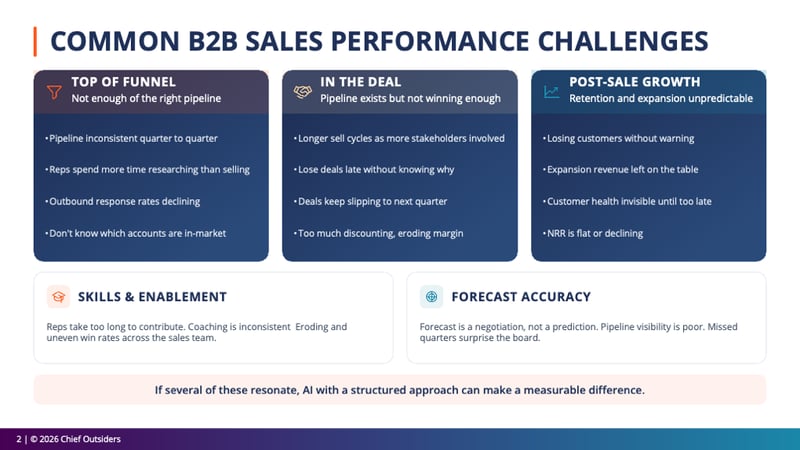
Across all industries, B2B sales is becoming more difficult. Common B2B challenges fall into five areas:
- Top of Funnel – not enough of the right pipeline
- In the Deal – pipeline exists, but not winning enough
- Post-Sales Growth – retention and expansion are unpredictable
- Skills & Enablement
- Forecast Accuracy
Companies do not have enough pipeline, and they are seeing longer sales cycles, declining win rates, and unreliable forecasts. There are several reasons, including buyers doing their own research in advance, sellers being viewed as not adding value, the expansion of buying groups, and prospects losing confidence that they can make a low-risk, high-quality decision. As a result, 40–60% of deals lost today are due to inaction, or to smaller and safer price-driven purchases.
The AI Opportunity
The good news is that industry research indicates that AI can have a significant impact on sales performance, including up to a 28% increase in win rates with AI-guided selling (Gong Labs) and a 40% reduction in time spent on non-selling activities (McKinsey).
The bad news is that figuring out how to do this effectively isn’t easy. The vendor landscape is overwhelming with hundreds of SaaS companies claiming they have the answer. Figuring out how foundation models, AI assistants, AI-powered tools, and agentic AI all fit together adds another layer of complexity. CRM data quality and integration is also a barrier, and sales rep adoption is why most AI sales investments stall. Finally, without success metrics in place before purchase, it’s very difficult to measure ROI. What you can be sure of is that your competitors are already investing in AI to improve sales performance. The companies that get there first will establish a compounding advantage leading to higher win rates, shorter sales cycles, and a cost of customer acquisition their competitors simply can’t match.
AI Sales Applications
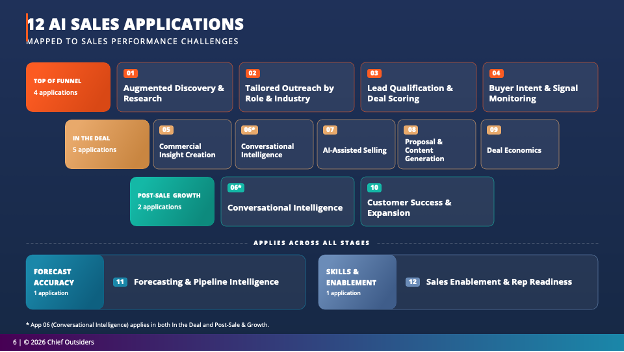
The framework spans 12 application areas across five core sales performance challenges, from augmented prospecting and buyer intent monitoring to conversational intelligence and AI-assisted selling, as well as forecasting, pricing, and skills development. Each application area maps to specific AI tools and a defined set of success metrics.
AI Capabilities
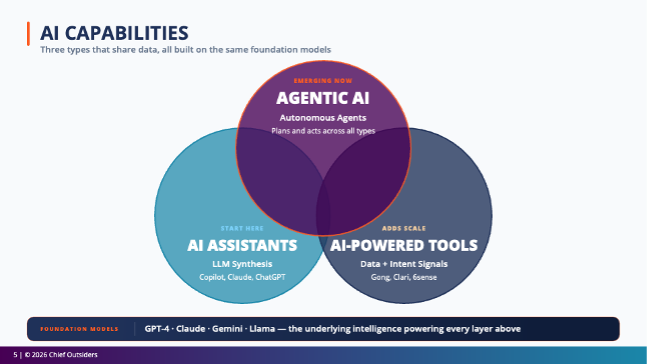
There are three types of AI capability that sit on top of foundation models, and you will likely use all three to improve sales performance.
Foundation Models are the underlying AI intelligence that everything else is built on — you don’t interact with them directly. These are the large language models built by companies like Anthropic (Claude) and OpenAI (GPT-4), trained on vast amounts of data to understand and generate language, reason through problems, and follow instructions. Think of them as the engine under the hood of every AI tool you use.
AI Assistants are general-purpose tools built on top of foundation models that augment what a person is doing today. You interact with them conversationally by asking questions, drafting content, summarizing information, and doing research. They’re flexible and broad, but they don’t have access to your proprietary data or your company’s systems unless you connect them. Examples include: Claude, ChatGPT, Microsoft Copilot, Perplexity. They’re fast to deploy, easy to adopt, and a natural starting point for most sales teams.
AI-Powered Tools (Proprietary) are purpose-built applications that combine foundation model intelligence with proprietary data including their own databases, industry-specific training, or direct integrations with your CRM and sales stack. This is the critical distinction from AI Assistants: while assistants are broad and flexible, they're essentially blind to your world as they don't know your customers, your pipeline, your competitors, or your historical deal patterns. Because they're built for a specific job and trained on sales-specific data, AI-powered tools can do things a general assistant simply can't: score leads against a database of 300 million contacts, analyze your call recordings against winning patterns, and predict deal outcomes based on your own historical pipeline data. Examples: Gong, 6sense, ZoomInfo, Clari, Apollo.io, Highspot. Higher impact than AI Assistants, but more complex to implement and more expensive — which is why sequencing and prioritization matter.
Agentic AI is AI that doesn't just respond to your questions. Instead, it plans and executes multi-step tasks autonomously. You give it a goal, and it figures out the steps, uses tools, makes decisions, and completes the work with minimal human direction. In a sales context, this might mean an agent that researches a prospect, identifies the right contacts, drafts personalized outreach, schedules follow-ups, and updates the CRM, all without a sales rep doing each step manually. This is the frontier of where AI is heading, and while early use cases are already emerging, most companies are still building the foundation they need to deploy agents effectively.
Suggested Approach
Here is a three-step process to help you cut through the AI capabilities maze so you can start getting measurable improvement in sales performance using AI:
1. Assess & Diagnose
- Assess your current pipeline, sales processes, CRM data quality, existing AI sales tools, and their adoption rates.
- Prioritize sales performance challenges and identify where AI will have the most impact
- Consider sales team readiness
- Develop a 12-month roadmap that lays out which applications you want to focus on
2. Pilot
- Select one area from the roadmap to pilot first, balancing impact with speed to value
- Define the baseline and 2-3 success metrics to establish ROI before any tool purchase
- When evaluating AI tool vendors, consider how well they integrate with your CRM, your sales team size and budget. Avoid solution sprawl by prioritizing solutions that can cover more than one of your roadmap applications.
3. Deploy & Scale
- Develop an education and training plan to ensure adoption
- Track performance metrics monthly to ensure ROI achievement
- Establish a Governance Framework that considers data sharing requirements (including with external parties and sensitive client information) and a process for adding additional AI capabilities
AI won't fix a broken sales process but applied to the right challenges in the right sequence it's already delivering measurable results for B2B sales teams. To learn more about how the Chief Outsiders AI Sales Performance Accelerator can help your team build a structured roadmap for AI adoption, contact Neil Isford at nisford@chiefoutsiders.com or visit chiefoutsiders.com.

Topics: Business Growth Strategy, Sales Strategy, CEO Business Strategy, Sales Enablement, AI, Strategy
/Neil-Isford.jpg?width=200&height=200&name=Neil-Isford.jpg)
Related Articles