.png?width=1500&height=398&name=CO_Corporate%20Logo%202021_4C_HOR_FNL-1%20(1).png)

You Can't See Growth Looking Only Inside the Business
You can run a company from inside the four walls.
You can't grow it well from inside the four walls alone.
Strong operators tend to know their businesses exceptionally well. They understand their people, processes, customers, financials, sales performance and operational constraints.

The Four Basic Pillars of Digital Economics
Sat, Feb 16, 2013 — For many companies in both the B2C and B2B markets, selling online is a must. Whether selling digital goods like downloadable software, SaaS-model subscription offerings or actual physical goods, in my experience there are a few straight forward and basic economic pillars of selling online that are often overlooked. While your products, pricing and promotions are important, I’ve seen that a renewed focus on the intersection of these four pillars delivers significant increases in sales. These pillars are: • Traffic • Close rate • Average order value (AOV) • Retention
6 Reasons for Marketing Involvement In Supply Chain Management
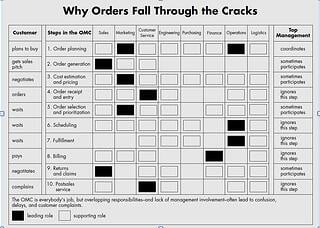
Mon, Oct 22, 2012 — Customer Relationship Management The idea that a company can increase their competitiveness by focusing on how a company interacts with its customers is not new but little has been accomplished to this end across corporate America. In 1992 the Harvard Business Review published a ground-breaking paper called Staple Yourself to an Order. I came across this paper several years after it was written, while I was in an operations and logistics role and it captured my imagination. In essence what the paper was saying is that companies did not have an end-to-end process around customer relationship management. There were no processes in place to manage the customer at every interaction point in a consistent manner. There is a great chart in this document on page 6 entitled "Why Orders Fall through the Cracks" (see below) that really captures the issue and illustrates a typical organizational structure and what happens to a customer going through the entire process of placing an order.