.png?width=1500&height=398&name=CO_Corporate%20Logo%202021_4C_HOR_FNL-1%20(1).png)



The New PE Value Creation Playbook: Part Six
The Flexible Operating Model for Commercial Growth
Operating partners have a lot on their plate when it comes to value creation.
As returns increasingly depend on durable commercial growth systems, PE firms need people who can help translate the investment thesis into action. At the same time, it’s unrealistic for most firms to build every operating capability internally.
This is especially true in the mid-market.
Many mid-market companies could use access to commercial expertise – from senior level strategy to execution resources – but they don’t need it full time, all the time. A portfolio company may need a commercial roadmap during the first 100 days, execution resources during the mid-hold period, or exit-readiness support as the company prepares for sale.
That creates demand for a flexible operating partner model.
In this model, PE firms gain access to experienced commercial operators who can work as part of the portfolio company to build a durable growth system. These operators do not simply advise from a distance – and they don’t come in thinking about running a campaign or a one-time lift. They’ve built growth systems before and know how to diagnose the commercial gaps, design the growth architecture, and activate the plan.
The goal is not dependency. The goal is building a system that can run effectively even if they leave – and even after exit. A flexible operating partner model helps the portfolio company become better at managing growth, bringing in senior leadership where needed, execution capacity where missing, and operating discipline where the business is fragmented.
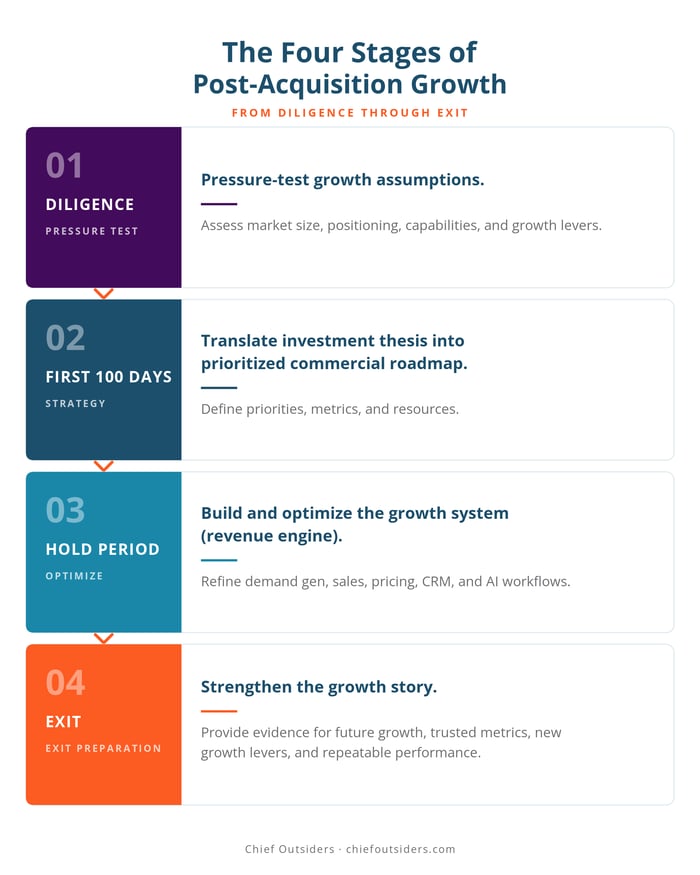
The model is especially powerful across the investment lifecycle.
-
Diligence: During diligence, flexible teams can pressure-test the growth assumptions behind the deal. Is the market large enough? Is the positioning strong enough? Are the sales and marketing capabilities mature enough? Are the growth levers realistic?
-
First 100 days: Immediate after acquisition, they can help translate the investment thesis into a prioritized commercial roadmap. What should happen first? What must be fixed? Which metrics matter? Which resources are missing?
-
Hold period: During the mid-hold period, they can help build and optimize the revenue engine. This may include demand generation, sales process, pricing, CRM discipline, customer expansion, AI-enabled workflows, or execution support – in short, a growth system.
-
Exit: During pre-exit preparation, they can help strengthen the growth story. What evidence supports future growth? What metrics will buyers trust? What next-wave growth levers remain? How can the company show that performance is repeatable?
This is where the flexible operating model creates leverage. It gives PE firms immediate access to the commercial capabilities they need, when they need them, without burdening the portfolio company with permanent staffing they may not fully utilize later.
The value is clear: scalable commercial expertise that helps build durable growth systems through the hold period and stronger growth confidence at exit.
Key Takeaway
PE firms and their portfolio need a way to scale commercial operating expertise across the portfolio without burdening the portfolio company with permanent staffing. The next operating partner advantage isn’t a larger internal team. It’s a more scalable, flexible operating model.

Catch up on the full series
- AI-Enabled Growth Needs Human-Led Commercial Discipline
- The Flexible Operating Model for Commercial Growth
Topics: Business Growth Strategy, Value Creation, Private Equity
/cmo-Slade-Kobran.jpg?width=200&height=200&name=cmo-Slade-Kobran.jpg)
Related Articles