.png?width=1500&height=398&name=CO_Corporate%20Logo%202021_4C_HOR_FNL-1%20(1).png)



The New PE Value Creation Playbook: Part Three
The Anatomy of a Durable Commercial Engine
"Private equity firms will have to work harder in order to deliver superior returns." — Bain & Company
If private equity firms want portfolio companies to create durable value, they need to look beyond individual growth tactics and assess the commercial engine itself.
Most portfolio companies are not standing still.
A durable commercial engine is the system through which a company identifies, pursues, wins, retains, and expands the right revenue opportunities. It is how growth gets managed inside the business.
This engine does not depend on one campaign, one executive, one sales hire, or one market push. It combines strategy, talent, technology, data, process, and execution into a repeatable operating model.
At a minimum, a durable commercial engine includes four connected components.
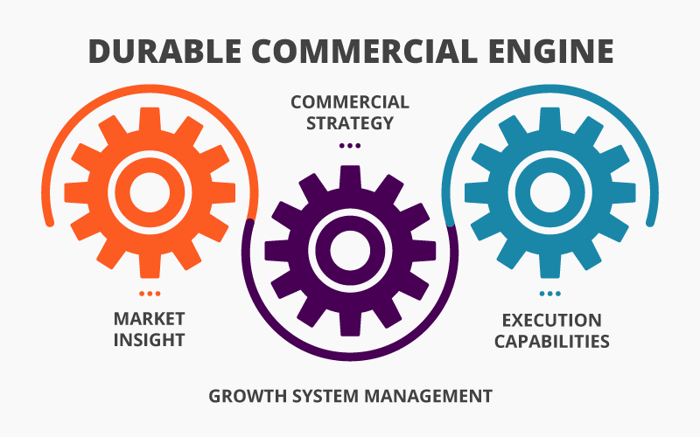
1. Market insight
Every growth system starts with a clear understanding of the market.
Which segments are most attractive? Which customers are most profitable? Where is demand shifting? What problems are buyers trying to solve? How is the competitive landscape changing? Where does the company have permission to win? Where is the market overestimating or underestimating the company’s value?
Without strong, sustained market insight, portfolio companies often spread resources too thin. They chase too many segments, accept too many low-quality opportunities, or build strategies around internal assumptions rather than external reality.
For PE firms, market insight is not academic. It determines where growth capital, leadership attention, sales effort, and marketing investment should go.
2. Commercial strategy
Insight becomes valuable when it leads to the right choices.
A durable commercial engine requires clear decisions about where to play, how to win, which customers to prioritize, how to price, which channels to use, and how growth connects to the investment thesis.
Strong commercial strategy creates alignment. It tells the organization what to pursue, what to stop doing, and how success will be measured. If a portfolio company is chasing too many priorities, speaking to too many audiences, or sending too many disconnected messages, the issue is not just execution. It is a lack of strategic alignment.
In a growth system, that alignment matters most across sales and marketing. In many portfolio companies, marketing and sales are not aligned around the strategy or the activation plan. A durable commercial engine gives sales and marketing one view of the buyer journey, one definition of a strong opportunity, and one shared process for moving prospects from interest to revenue.
3. Execution capabilities
Strategy is important – but execution is where it comes to life.
A durable growth system requires an activation plan aligned to the strategy, and requires availability of resources to execute on that plan quickly and effectively. Even with the plan, portfolio companies may lack the people, time, or specialized skills to run it. Successful plans require demand generation, sales enablement, CRM support, content development, analytics, pricing analysis, customer research, website optimization, proposal support, or AI-enabled workflow development.
This does not always mean adding permanent full-time headcount, especially to build the system in a changing market. It means ensuring the company has the right capabilities at the right time. Often, that means having access to flexible resources that can come in as needed.
Execution capacity is no longer just about people. Technology — especially AI — is now a core part of how growth gets activated. When applied to a strong commercial system, technology can improve efficiency, increase productivity, surface better insights, and accelerate AI-enabled growth.
But technology cannot compensate for a weak system. If AI is treated as a standalone initiative or layered in with an unclear strategy, poor data, or disconnected processes, it can create more noise than value. The goal is not to add tools for their own sake. The goal is to use technology to strengthen the commercial engine the company is trying to build.
4. Growth System Management
Markets change. Buyers change. Competitors change.
Your growth system must change with it. And that means performance must be visible.
A durable commercial engine requires reliable, practical KPIs and a regular operating cadence for using that data to drive decisions. The right metrics include both leading and lagging indicators, helping the company understand not only where the business is today, but where it is heading. The company needs to know what is working, what is not, where to intervene, and where to invest.
Metrics must include pipeline quality, conversion rates, lead source, sales cycle length, win/loss patterns, revenue by segment, customer acquisition cost, retention, expansion, pricing realization, and forecast accuracy.
But data alone is not enough. A durable commercial engine includes a repeatable rhythm for performance review, making decisions, and adjusting execution. This cadence, when finely tuned, turns commercial execution into a managed operating discipline.
The company is not simply executing a plan, it is building the muscle to keep improving.
Putting it all together
When these four components – insights, strategy, execution, and system management - are connected, the portfolio company becomes more viable and scalable. Growth becomes easier to manage and easier to maintain. Well-driven portfolio companies' are set to perform during the hold period and show buyers that growth is not a one-time phenomenon.
Key Takeaway
The question for PE firms is not whether a portfolio company has growth potential. It is whether the company has the system to capture it. If this raises questions about your portfolio companies' commercial engines, feel free to reach out for a conversation.

Catch up on the full series
Topics: Business Growth Strategy, Value Creation, Private Equity
/cmo-Slade-Kobran.jpg?width=200&height=200&name=cmo-Slade-Kobran.jpg)
Related Articles