.png?width=1500&height=398&name=CO_Corporate%20Logo%202021_4C_HOR_FNL-1%20(1).png)
The Chief Outsider
.svg)
Recent Posts

Turning Customer Insight into Customer Value
This blog is part of Chief Outsiders’ New Growth Imperative series, designed to help CEOs and leadership teams engage executive decision-makers at targeted strategic accounts by turning deep insights into compelling customer value.

Six Questions to Diagnose Customer Service Issues At Your Company
Thu, Jan 31, 2019 — It seems as if it was only yesterday when marketing analysts were declaring 2018 as “The Year of the Customer.” Trends in technology, along with competitive pressures, had finally shifted the balance of transactional power into the hands of the consumer. On that notion, let me share with you a story about someone I know. It’s a story that, in fact, you may have experienced personally. This individual had a wallet filled with credit cards and held multiple bank accounts with a large financial services company. Never giving the relationship much of a second thought, they left their checking, money market, credit cards and other banking products on autopilot. Then one day, for no apparent reason, they suddenly stopped working. All of these products, simultaneously. Suddenly, they couldn’t access balances, and their credit card was declined at the cash register. This person—hopeful that a reasonable explanation defined this issue, and eager to get a quick resolution—called the bank. Three days and six hours later, and after talking with no less than 12 people, their accounts were finally active. The original glitch, it turns out, was entirely the fault of the financial services provider.

A Practical Guide to Using Fractional Marketing and Sales Execs: What Small- and Mid-Sized Business CEOs Need to Know
Tue, Jan 22, 2019 — Written by: Mark Coronna, Partner & CMO--Chief Outsiders with Jeff Parris and Daniel Steyn, Fractional Sales Executives--Sales Xceleration The use of fractional executives (also referred to as interim, part-time, on-demand, or outsourced executives) has traditionally been related to business functions such as finance, human resources, or technology. The use of the word “traditionally” deserves to be put into perspective. The oldest and largest fractional executive company, B2B CFOs, was founded in 1987. This article will drive three major points: Fractional execs are a relatively new option for small- and mid-sized businesses (SMBs) Small- and mid-sized businesses are in a great position to secure significant value from this leadership staffing model While fractional Marketing and Sales executives are a “newer” concept than using fractional execs for back-office functions, fractional Marketing and Sales execs can provide critical expertise and timely support for SMBs with growth challenges or those interested in more rapidly accelerating growth! We are going to use the terminology “go-to-market executives” to refer to both fractional Marketing and Sales execs. These roles are not the same but are compatible and collaborative when helping set and execute a business’ growth agenda.

CEO Growth Series: Challenge #2 - Working in Your Business Instead of on Your Business
Mon, Jan 21, 2019 — CEOs come in many different flavors… sales-oriented, product-focused, operations, finance, and other disciplines. Often, where you are most comfortable, and where you dive in deep is in the area of your own prior experience. With every company I have engaged with, I see this challenge: the CEO is so involved in the business and working in their comfort zone that they can’t see the wider perspective. They’re so in the business that they’re not working on it. Growth suffers as a result. Most CEOs are not aware of the problem. They’re just completing activities, like arranging chairs on the deck of the Titanic while the ship is sinking. It’s also hard to self-diagnose. And, you’re not going to hear about it from people on the inside. So, to be clear and as helpful as possible: If your business is not at least tracking with the industry growth rate, there’s a problem, and it’s with your company. It may be time to step back and work on your business.

CEO Growth Series: Challenge #1 - Lack of Focus
Wed, Jan 16, 2019 — Overcoming the most common impediment to business growth You can see it in their faces. The look of a tired or burned out entrepreneur with not enough time or resources to outrun the wave. Sound familiar? If you’re currently moving at 100 miles per hour and not accomplishing much, or you wonder if you are doing the right things, or you see lots of activity but not much in the way of results, you and your organization are probably suffering from a lack of focus. Lack of focus is the most common business problem standing in the way of growth and one of the hardest to resolve.

How Small- and Mid-sized Business (SMBs) Can Execute the “Virtuous Cycle” of Digital Growth
Thu, Dec 13, 2018 — This is the final installment in our series. This article will emphasize effective adoption of best practices, offer a logical sequence to implementation, and discuss building organizational and program maturity. This article will help you understand how to achieve “digital growth champion” status. This is also the last in a series of five articles focused on helping executives in small- and mid-sized businesses utilize digital technologies effectively to assist in accelerating revenues and profits. If you missed the first four articles, you can find them here: Article 1 Article 2 Article 3 Article 4

Aligning Business Strategies and Digital Platforms to Drive Growth in Small- and Mid-Sized Businesses (SMBs)
Thu, Dec 6, 2018 — This is the fourth in a series of articles focused on helping executives in small- and mid-sized businesses utilize digital technologies effectively to assist in accelerating revenues and profits. If you missed the first three articles, you can find the first here, the second here, and the third here. Three previous articles included an introduction to four major ways digital technologies can help your business and described a spectrum of technologies and a possible implementation roadmap, and associated digital proficiency with enhanced business performance. We also looked at how business process needs and priorities should help guide your digital paths and how to organize your people for success. We are ready to discuss the third step on the “USA” digital roadmap: “Implement New Platforms and Technology.”

Maximize Your Growth Potential by Supercharging Your Learning Agility
Thu, Nov 15, 2018 — Imagine how much more money your company could make if you never made the same mistake twice. How much more successful would you be if you could quickly course correct every time a plan went awry? What new growth initiatives could you pursue with expanded capabilities? How much would your productivity increase if you could improve your ability to attract and retain top talent? Supercharging your company’s learning agility can drive material improvement in each of these areas. It will also enable your company to maximize its growth potential. Learning agility is the willingness and ability to learn from experience and insight, then leverage that learning to perform better. While companies have always needed to learn and adapt to be successful, changes in technology, consumer preferences, and political and economic forces make it difficult for them to keep their growth plans on course. Access to data and emerging technology has weakened industry barriers to entry, while simultaneously leveling the playing field for competitors. In today’s complex business environment, companies that learn and adapt will be the most successful.

Sales vs. Marketing: Chicken or Egg First?
Thu, Nov 15, 2018 — What comes first, adding a sales person or having ready prospects and opportunities to pursue? I once worked for a company where Sales held all the power – more than product development or finance and certainly more than marketing. I recall a discussion with a long-time senior executive about the amount of marketing investment required for the company to profitably grow. She commented that the company had a tried and true method of driving growth. “We don’t need to invest in marketing. For every sales person we add, then revenue will grow!”, she proudly exclaimed. This had indeed been true at one time in the company’s history, but along with that revenue growth came increased expenses and decreasing sales productivity. The company eventually went through an inevitable and painful exercise of downsizing a much too large sales force.
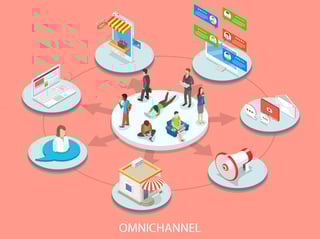
Omnichannel or Tunnel Vision?
Tue, Nov 6, 2018 — Journey with me back a few years, to a time when books were bought at a bookstore, clothing purchased at an apparel shop, and the concept of competitive shopping was limited to letting our fingers do the walking. Today, consumers are fully – and indelibly – in control. Selling our stuff to this finicky lot requires a trip to their dimension – or we risk them not hearing us. That’s why today’s CEO is being assaulted by entreaties to institute an omnichannel strategy as an essential piece of their competitive marketing plan.