.png?width=1500&height=398&name=CO_Corporate%20Logo%202021_4C_HOR_FNL-1%20(1).png)
The Chief Outsider
.svg)
Recent Posts

Why MedTech’s Brilliant Innovators Must Also Become Commercial Architects
| Great technology is necessary. It is not sufficient. The graveyard of MedTech is lined with brilliant innovations that never found their market — not because of scientific failure, but commercial invisibility. |
I just returned from LSI USA ‘26 in Dana Point — the most impressive gathering of emerging MedTech talent I’ve witnessed in decades. The event convened 2,000 executives, 394 presenting startups, and over 500 active investors and strategics. The scientific ambition in that room was extraordinary.

YOU HAVE PERMISSION TO TAKE A BREAK.
Sat, Nov 9, 2013 — Guest Blog by Joanie Rufo, Initiate Consulting. One of the common themes I see in my work coaching executive leaders is the unilateral struggle of leaders to rest and renew. “EACH OF US NEEDS TO WITHDRAW FROM THE CARES WHICH WILL NOT WITHDRAW FROM US.” – Maya Angelou

The Power of Pricing: How to Improve Your Pricing and Profits
Wed, Oct 30, 2013 — Your sales team defines price as what’s on the invoice. Your CFO defines price as ‘what we take to the bank’. Your customer says price is too high. Your pricing manager says that price doesn’t match our standard terms. Your distributor says they can’t make any money on your line. And it’s still Monday morning! What’s the right way to define and measure price? More importantly, how can you improve net price realization and take more money to the bank? I define price as what goes to the bank, after all discounts, returns, warranties, commissions and other deductions are taken into account. There are several elements to price management. The first is achieving the optimal price for each good or service. The second is managing your product mix and services to achieve the optimal price for a set of customer transactions.

Outstanding CEOs Often Play It By Ear
Wed, Oct 16, 2013 — I did not like the Beatles when they first came to America, but I am a contrarian by nature. Today, John Lennon and Paul McCartney are music icons that created a legacy of sound and lyrics. The Beatles created some of the most recognized and memorable songs of today. "I don’t read music, you got a problem with that?" - said Paul McCartney. They created music from what came into their minds. How did they do this and become world renown? I suggest to you they “played it by ear.”

Let’s Talk Growth – 5 Questions CEOs Should Ask To Energize A Staff Meeting
Sat, Oct 12, 2013 — Twice this week, once at a client lunch and once during a dreaded staff meeting, the topic of unproductive staff meetings came up. This got me to thinking about the why. Upon reflection, is it because many of us focus staff meetings on the burning operational issues of the day, or because we focus on reviewing operational dashboards with little discussions of the 3rd, 4th or 5th "why" for average or lackluster performance? Jeff Bezos, when asked during his first meeting with Washington Post writers how he’d define success at the Post, replied “Growth."
How Companies Can Make Inevitable Mistakes Pay Off
Sun, Sep 29, 2013 — No one likes making mistakes, but we all make our fair share of them. Humans are fallible, products and processes fail, and things slip through the cracks. Even the best-managed companies can go awry. Unfortunately, mistakes are not only inevitable; they can also be very costly. As a CEO you know that mistakes can cause operations costs to rise and productivity to falter — and most damaging of all, they frustrate our customers so that they start thinking about taking their business elsewhere. If we act quickly to fix our mistakes, however, we can make our mistake pay off.

Transforming an Organization: The 4 Steps Every CEO Should Take
Sun, Sep 15, 2013 — Companies can no longer settle for incremental improvement in today’s rapidly evolving and increasingly global economy—organizational transformation is necessary. McKinsey Quarterly, in their June 2011 issue offered the suggestion that in order to sustain high performance, organizations today must build the capacity to learn and keep changing over time and suggested that organizational health was perhaps the ultimate competitive advantage for today's economy. I can not stress more strongly how important the role of the CEO is in visibly participating in transforming an organization and how the CMO can assist in this process. I believe there is no single model for success, and actions will be influenced by the magnitude, need and nature of the change for an organization. But, in my experience there are four steps every CEO should take to transofrm an organization. I've found these basic change management steps always apply and can be scaled to fit every organizational transformation. The premise of these four steps a CEO should take to transform an organization is based on two important tenets that I believe must be considered when implementing an organizational transformation. First, it is people and relationships that make up organizations, not buildings, systems or processes. And second, most people don't like being forced out of their comfort zones and they must have a reason to do so. With that said – lets review the four steps for integrating change management into a new business strategy.
Most Leaders are Made Not Born—And They Need to be Developed
Sat, Sep 14, 2013 — Born leader or made leader—do they both exist? There is a world of difference between knowing about leadership and becoming an effective leader. I may be wrong about this, but from my reading and conversations with colleagues and clients, I get the impression that relatively few supervisors and managers and even fewer C-level executives, entrepreneurs and board members actively pursue disciplined professional leadership development. They read books, articles and blogs about leadership, and they attend workshops and seminars—so they know about leadership. But were they born leaders or are they made leaders?
Email Is Not Always Your Friend – Three Ideas for Better Management
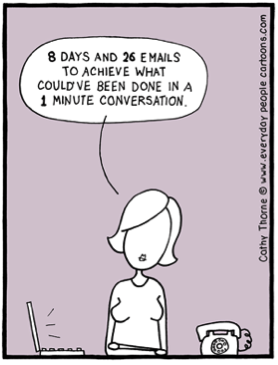
Wed, Sep 11, 2013 — It’s Not Just a Problem of Volume The immense volume of email that many of us receive each day can make email seem like an unbeatable adversary in a battle between responding to messages and getting the work done that we had planned. It is always a bit impressive, therefore, when people come up with a system for dealing with email overload that actually works for them. For instance, Both Zappos CEO Tony Hsieh and LinkedIn CEO Jeff Weiner have developed their own systems for handling email and staying productive rather than email being a constant, nagging drag on his day. Their systems won’t work for everyone, but they are good examples of taking a systematic approach to email.

Start Using Market Research Strategies to Drive Your Company’s Growth
Sat, Aug 24, 2013 — Market Research Strategies: Getting to Your Company to The Next Level Quite often these days, especially evident in mid-market businesses, I come across CEOs, who have been very successful at building their company’s revenues but are now are challenged with reaching the next level. Sales may have slowed down; the low hanging fruit picked; or competitors are upping their game. They may also have been successful in using their technology and expertise in one market, but totally misread another. Whatever the issues are; in order to flourish, every company should consider integrating market research strategies into their growth plan to keep a pulse on their market and its dynamics and to capitalize on market opportunities. Growing through market research strategies can include new products and services, new pricing plans, new positioning, new market segments, changes in business models, or new channels of distribution. Each of these should be evaluated, researched and integrated into your growth strategy and ultimately into your business, product development, and tactical go-to-market plans.