.png?width=1500&height=398&name=CO_Corporate%20Logo%202021_4C_HOR_FNL-1%20(1).png)

Your Buyers Have Already Shortlisted You—Or They Haven't
Part 3 of our four-part series on the evolving AI search landscape and what B2B leaders need to know to stay competitive.

Maximize Your Growth Potential by Supercharging Your Learning Agility
Thu, Nov 15, 2018 — Imagine how much more money your company could make if you never made the same mistake twice. How much more successful would you be if you could quickly course correct every time a plan went awry? What new growth initiatives could you pursue with expanded capabilities? How much would your productivity increase if you could improve your ability to attract and retain top talent? Supercharging your company’s learning agility can drive material improvement in each of these areas. It will also enable your company to maximize its growth potential. Learning agility is the willingness and ability to learn from experience and insight, then leverage that learning to perform better. While companies have always needed to learn and adapt to be successful, changes in technology, consumer preferences, and political and economic forces make it difficult for them to keep their growth plans on course. Access to data and emerging technology has weakened industry barriers to entry, while simultaneously leveling the playing field for competitors. In today’s complex business environment, companies that learn and adapt will be the most successful.

Sales vs. Marketing: Chicken or Egg First?
Thu, Nov 15, 2018 — What comes first, adding a sales person or having ready prospects and opportunities to pursue? I once worked for a company where Sales held all the power – more than product development or finance and certainly more than marketing. I recall a discussion with a long-time senior executive about the amount of marketing investment required for the company to profitably grow. She commented that the company had a tried and true method of driving growth. “We don’t need to invest in marketing. For every sales person we add, then revenue will grow!”, she proudly exclaimed. This had indeed been true at one time in the company’s history, but along with that revenue growth came increased expenses and decreasing sales productivity. The company eventually went through an inevitable and painful exercise of downsizing a much too large sales force.
Omnichannel or Tunnel Vision?
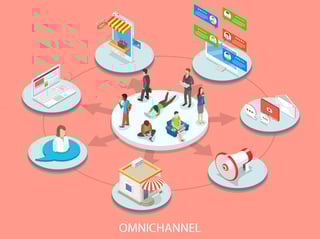
Tue, Nov 6, 2018 — Journey with me back a few years, to a time when books were bought at a bookstore, clothing purchased at an apparel shop, and the concept of competitive shopping was limited to letting our fingers do the walking. Today, consumers are fully – and indelibly – in control. Selling our stuff to this finicky lot requires a trip to their dimension – or we risk them not hearing us. That’s why today’s CEO is being assaulted by entreaties to institute an omnichannel strategy as an essential piece of their competitive marketing plan.

Are You Using Your KPIs Appropriately: Report Card or Predictive Data?
Fri, Oct 19, 2018 — Just a few weeks ago, I enjoyed yet another screening of the 1976 movie The Gumball Rally. If you’ve never seen it, it’s a slapstick satire about a wild and crazy cross-country race. The competition starts in New York City, with a goal to finish in the shortest amount of time. During the trek, a driver named Franco rips the review mirror off his windshield and dramatically announces the first rule of Italian driving: “What’s behind me is not important!” Even though I’ve heard this line plenty of times, I couldn’t help but chuckle. This belief is not only applicable to the business world – but appropriate when creating and measuring your company’s Key Performance Indicators (KPIs). According to Investopedia, a KPI is a set of measurable data that a company uses to gauge its performance over time. Examples include return on marketing investment, customer lifetime value (LTV), and customer acquisition cost (CAC). There are endless performance indicators you can use to measure your business goals.

Shift Your Brand Perception - Start with Getting Your Positioning Right
Thu, Sep 20, 2018 — In my previous post, we reviewed how brand perception specifically impacts company growth and profitability. Now we’ll cover the keys to building the foundation for communicating about your company. When companies start out, they usually have a very clear understanding of who their customer is, the problem they are solving, and possibly, how they are different. This is typically because they have a single product for a single market segment where they’ve achieved some level of success. But over time, as companies and markets evolve: The competition becomes more intense, either through matching capabilities, building new capabilities or new competitors appearing. Customer needs and priorities change. What was important to a customer 3 years ago may not be as important today. The company enters new market segments or geographies. There may be subtleties between industries, regions and countries in terms of priorities and pain points. The company broadens its portfolio of offerings. As more products are developed and more problems addressed, there might be new buyers and other selling dynamics.

Building a Long-Lasting Relationship Between Hispanic Consumers and Your Business
Tue, Sep 18, 2018 — When a business looks at how to approach the U.S. Hispanic consumer, it is quite easy for it to rely on commonly known facts: Family is important to them, their households are larger, and they over-index usage of mobile devices to gather information and shop online. Let’s not forget that they love soccer – and are deeply religious. However, to develop the most meaningful connection, it’s essential to dig a little deeper than the obvious. The same analytical rigor and behavioral curiosity we apply to our core US consumer (also known as the general population) needs to be involved in studying the Hispanic consumer and how they relate to your category. First, we’ll begin with an examination of the data, then uncover insights to understand what truly matters to this exquisite target.

CEOs, Are You Confident in Your Marketing Team’s Ability to Drive Growth?
Mon, Sep 17, 2018 — While most mid-sized companies have invested in dedicated, in-house marketing teams, many executives are not pleased with the return on investment. A survey conducted by The Fournaise Marketing Group revealed that 73 percent of CEOs believe their marketing team is not capable of generating enough growth. An astonishing 80 percent of the CEOs polled don’t trust their marketing teams. There is widespread concern that the marketing function is unable to deliver a positive ROI for the department’s spending. CEOs also doubt marketing’s ability to use data to make informed decisions. You may have some of the same concerns for your marketing organization. Much has changed in marketing over the last several years, but its core purpose has stayed the same. The American Marketing Association defines marketing as the “activity, set of institutions, and processes for creating, communicating, delivering, and exchanging offerings that have value for customers, clients, partners, and society at large.” Despite the challenges of an ambiguous and rapidly evolving business landscape, marketers must drive growth and prove their value to their company. This can be accomplished by focusing on marketing’s core responsibility: delivering value to customers and stakeholders.

“Wake Up Airplane!” – The Customer Journey Driving Delta
Fri, Sep 14, 2018 — At a major U.S. airport on a recent dark early morning, two major airline mechanics reported for work. Their job: To “wake up” the airplanes at the gate, in the dark, to get them ready for the day’s service. This requires activating and checking various systems on each airplane so that a “dark” airplane “awakes” from its overnight sleeping. Lights turn on, systems are activated, and everything is checked for the first flights of the day. One recent morning, however, this routine changed. The two mechanics indeed performed their required duties. Except this morning, they decided to scour the gate area for families with young children -- sleepy and crabby in the early morning dark -- and asked their parents if the kids could help “wake” the airplanes. The kids jumped at the chance. One mechanic in the terminal handed his radio to the kids, and had them say “wake up airplane” to the other mechanic, waiting on the plane. Lo and behold, like magic, the airplane came alive – lights glistening in the pre-dawn darkness, now “awake” for the day’s service. The kids, of course, were thrilled: They got a chance to talk to the mechanics, and a taste of the airplane business (which might motivate some of them to join the industry someday). Incidentally, this is now a ritual that these mechanics engage in on a daily basis.

The US Hispanic Consumer Cultural Evolution: You CAN Have Your Cake and Eat It Too
Tue, Sep 4, 2018 — Hispanics, or Latinos (which kindly includes my native country, Brazil, where we speak Portuguese), have been a strong influence in the US economy for decades. As an integral part of the workforce seeking the “American Dream”, more and more Latinos tried, as time went by, to “fit-in” to the American culture to succeed and achieve that Dream. Latino parents would only speak English with their kids, so they would fit-in in school. When American neighbors came to visit, they made sure to serve peanut butter and jelly sandwich for the kids and hot dogs for the adults (“keep the tamales in the fridge, Mi Amor!”). You get the picture. The process of trying to “fit-in” to an alien culture is called acculturation. It does not have much, if anything, to do with which generation you belong to, but it is a phenomenon statistically proven to be correlated with two major variables: How easily you flip-flop from your native language to the country language. In this case, how effortlessly a Latino goes back and forth between Spanish (or Portuguese) and English, and; How similar the purchase basket is of a Latino family or individual to an American one.