

Does Your Contracting Pipeline Live in the Owner’s Head?
Relationships matter in construction, and most subcontractors have good ones. The owner or president carries the key customer relationships, and the project managers carry everything else. That arrangement can work well. It is also fragile. In our last post, we asked whether you know by name who owns each strategic account. This one looks at what happens when the answer is the owner.

When Hiring a CMO, Ask These Three Crucial Questions
Thu, Mar 25, 2021 — A senior marketing executive can revolutionize a company’s growth, but choosing the right candidate requires asking three key questions to understand first what the company needs, and then if the candidate can deliver it. There are times when a Chief Marketing Officer might not feel like a necessity, especially for a middle market company that has managed to grow well without one. But what worked for years can falter: growth stalls, a competitor begins to dominate the market, or new investors arrive with a more ambitious vision for the enterprise. And that can prompt the hunt for a new marketing leader. Like any talent search, the process can seem obvious in theory, but much more daunting in practice. People might have the right names on their resume and glowing references, only to still prove a bust when faced with the unique circumstances of a given business.

Top 10 FAQs: What CEOs Ask Chief Outsiders
Mon, Aug 24, 2020 — CEOs connect with us because they’ve been referred by one of our clients, their private equity firm, or have found us by searching for “top strategic marketing consulting firms” or something similar. When we meet, we often find that these CEOs are frustrated with their growth. They have a vision for where they want to take their companies, but don’t have a means to turn their vision into actionable plans, and then see them implemented. After a discussion around their specific business challenges and opportunities, they’re curious about the specifics of how Chief Outsiders might be able to help.

Profitable, Recurring Revenue Streams - Part 2
Fri, Jul 7, 2017 — Transitioning Your Business Model to Grow Your Business-as-a-Service More and more companies are realizing that transitioning their business to an as-a-Service model is the answer to driving higher growth and more profitable and stable revenue streams. In Part 1 of this article series, you learned how to know if it's time to think about embracing an as-a-Service model.

What Does a Fractional CMO Cost?
Wed, Oct 12, 2016 — A Growing Spectrum of Fractional CMO Service Providers Ensures a Range of Fee Levels More CEOs are hiring fractional executives to bring expertise to their management teams, but are they really affordable? And how should a CEO evaluate their value and the quality of work they deliver? These are really good questions! After all, there’s a wide range of skills, seniority and experience from marketing consultants, agencies and firms that call themselves fractional or outsourced CMOs. So, as you’d expect, there’s a wide range of price points from these sources. But to get started, let’s put these into a few oversimplified categories: “Single Shingle” Marketing Consultants “Loose Confederations” of Brokered Marketing Consultants “Professionals” who are Part of a Firm Senior management from a marketing or advertising agency Partners from an “Executives-as-a-Service” firm (such as Chief Outsiders) Partners from a large consultancy (such as McKinsey & Co, Bain)

Nine Reasons – Plus One -- To Hire an “Executive-as-a-Service”
Tue, Aug 11, 2015 — In my previous blog, I identified some of signs of “Business Malaise” that could signal a growing disconnect between the business vision and the company’s growth goals. And as noted, when you consider the competitive pressures wrought by the hyper-charged business universe, early indicators of corporate distress are best addressed sooner than later. Many small and mid-sized companies face this situation – desperately in need of skilled marketing expertise – but believing that they lack the resources to procure it. That is why I am devoting this post to explore a new option – the Marketing Executive-as-a-Service.

Transforming an Organization: The 4 Steps Every CEO Should Take
Sun, Sep 15, 2013 — Companies can no longer settle for incremental improvement in today’s rapidly evolving and increasingly global economy—organizational transformation is necessary. McKinsey Quarterly, in their June 2011 issue offered the suggestion that in order to sustain high performance, organizations today must build the capacity to learn and keep changing over time and suggested that organizational health was perhaps the ultimate competitive advantage for today's economy. I can not stress more strongly how important the role of the CEO is in visibly participating in transforming an organization and how the CMO can assist in this process. I believe there is no single model for success, and actions will be influenced by the magnitude, need and nature of the change for an organization. But, in my experience there are four steps every CEO should take to transofrm an organization. I've found these basic change management steps always apply and can be scaled to fit every organizational transformation. The premise of these four steps a CEO should take to transform an organization is based on two important tenets that I believe must be considered when implementing an organizational transformation. First, it is people and relationships that make up organizations, not buildings, systems or processes. And second, most people don't like being forced out of their comfort zones and they must have a reason to do so. With that said – lets review the four steps for integrating change management into a new business strategy.
6 Reasons for Marketing Involvement In Supply Chain Management
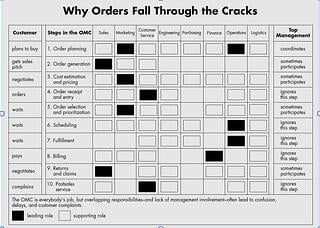
Mon, Oct 22, 2012 — Customer Relationship Management The idea that a company can increase their competitiveness by focusing on how a company interacts with its customers is not new but little has been accomplished to this end across corporate America. In 1992 the Harvard Business Review published a ground-breaking paper called Staple Yourself to an Order. I came across this paper several years after it was written, while I was in an operations and logistics role and it captured my imagination. In essence what the paper was saying is that companies did not have an end-to-end process around customer relationship management. There were no processes in place to manage the customer at every interaction point in a consistent manner. There is a great chart in this document on page 6 entitled "Why Orders Fall through the Cracks" (see below) that really captures the issue and illustrates a typical organizational structure and what happens to a customer going through the entire process of placing an order.
Growth Opportunity: The Demand Chain
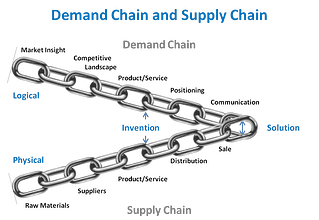
Mon, Mar 19, 2012 — Efficiency Only Goes So Far The last ten years of American business have been focused on integrating and perfecting operational efficiencies through the perfection and active management of the Supply Chain. For the last couple of years of economic turmoil, many companies have almost exclusively focused on supply chain efficiencies as a strategy for survival. Now the challenge is taking the expertise and company culture focused on linear thinking and introspection of the supply chain and start growing again.