.png?width=1500&height=398&name=CO_Corporate%20Logo%202021_4C_HOR_FNL-1%20(1).png)

The Contrarian Brand Play: Why Right Now Is the Best Time to Invest in Brand
Part 4 of our four-part series on the evolving AI search landscape and what B2B leaders need to know to stay competitive.

CEO Preparedness Guide for the Post-Pandemic Recovery: Planning for the Rebound
Wed, Jun 10, 2020 — Like the eye of a hurricane, businesses raked by the leading edge of the COVID-19 pandemic are now taking a cautious look outside. Though the winds have subsided, and it’s tempting to think that the worst is over, the eye simply gives us a chance to prepare for what’s left to come. If you have withstood the worst of the impacts of the pandemic so far, you likely have accepted that the storm was coming, and had battened down your hatches (or at least applied for PPP funding to keep vestiges of your business afloat). Now, though, as we can start to imagine a future in which a return to a “new normal” is evident, it’s critical to have your plan in place when the rebound hits.

Buying Local: How Multi-Unit CEOs Can Win at Marketing in Anytown, U.S.A.
Wed, Jun 10, 2020 — There was a time, generations ago, when buyers didn’t venture too far from their home to satisfy their basic needs. Today, most consumers don’t think twice about using a few keystrokes to get the necessities shipped from some distant warehouse to their front door. Despite this phase shift, “buying local” remains a relevant concept, and even source of pride for communities that rally around the bricks-and-mortar businesses that still dot the landscape.

Part 4: How Does Employee Engagement Win the Growth Game?
Mon, May 4, 2020 — Culture Shift Now: Getting the Right Help for the Times Co-Authored by Marc Umscheid, CMO, Chief Outsiders and Kristin Anderson, Partner, LeadQuest Consulting Welcome to the fourth blog in our series on the importance of a more engaged culture in fostering growth at your company (if you'd like to read any of the previous posts, they can be found here: Part 1, Part 2, and Part 3). Clearly, a few things have happened in our world since our last blog – namely, the COVID-19 pandemic, and an economic slowdown that has left few businesses untouched, or unscathed. If you have been following our blog series, you may recall that we have been insisting that a carefully crafted culture goes hand and glove with a high effective growth strategy, – making the case for how your leadership shapes the engagement needed for growth. Though the world may have changed – the fundamental principles have not. How you lead your employees now will indelibly reflect upon your cultural and growth mindset. This is now more important than ever.

CEO Preparedness Guide for the Post-Pandemic Recovery: Avoiding the Ad-Budget Ax
Fri, Apr 24, 2020 — Blog 1: Avoiding the Ad-Budget Ax In these uncertain times amidst the COVID-19 pandemic, there are likely two distinct pathways for businesses to follow—adapt or perish. Because none of you reading this would ever consider just laying down your arms and not fighting for survival, I thought I’d share a couple of quotes from noteworthy types who chose the latter mindset, choosing to both adapt, and thrive, rather than just survive.

Achieving Revenue Growth and Excellent ROI with a Radio Restaurant Promotion
Thu, Mar 26, 2020 — Those of you in the restaurant chain or franchise business may enjoy the details of this successful restaurant promotion executed by Doug Reifschneider. Doug was Vice President of Marketing at Pita Pit at the time, but recently joined Chief Outsiders as a fractional CMO. The promotion involved six Pita Pit restaurants located in Northern Idaho and the Spokane area who agreed to pool funds to test a cooperative advertising program. The test included a guerrilla radio advertising tactic, print, social and email support with offers to encourage trade-up and increase party size.

How to Retain Customers and Develop Brand Advocates - Part 3
Thu, Oct 10, 2019 — Part 3 of 3: Winning Retention Marketing Strategies Retention marketing isn’t meant to replace acquisition marketing, but to work alongside it as part of your growth strategy. The activities associated with retaining customers and/or increasing customer value through re-purchasing or up-selling products and services, is less expensive than acquisition marketing. While you need both acquisition and retention marketing, you will get a better return from your investment in retention marketing and create customers for life. In the previous blog post, we discussed how to develop a retention marketing program that specifically addresses the needs of your business. But are there proven retention marketing strategies or tactics that should be considered regardless?

How to Retain Customers and Develop Brand Advocates - Part 2
Fri, Sep 13, 2019 — Part 2 of 3: Developing a Retention Marketing Program As we learned in my previous post, retention marketing encompasses the activities associated with retaining customers or increasing customer value through re-purchasing and up-selling products and services. It’s anywhere from five to 25 times less expensive than acquisition marketing—and done well can reduce the expense pressure of acquisition marketing to grow your business. Retention marketing should be a part of any business growth strategy. Retention marketing involves communicating with your customers in a way that helps you nurture and keep them. This should be an ongoing priority for the business with buy-in from the top throughout the entire organization. After all, you’ve all worked hard and spent a lot of money to acquire those customers.
How to Retain Customers and Develop Brand Advocates - Part 1
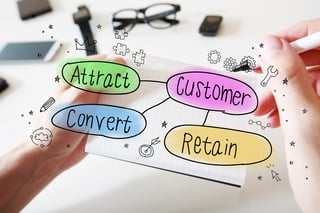
Fri, Sep 6, 2019 — Part 1 of 3: Why retention marketing should be part of your growth strategy If you are losing customers at almost any rate, you are jeopardizing your business growth strategy. Every lost customer creates a hole that you must fill before you can claim any new customer growth. The more customers you churn, the deeper the gap before you can realize any revenue or profit growth.

How to Generate Winning Results with PAC
Wed, Jun 19, 2019 — Most of us have heard of the Five P’s of Marketing (Product, Price, Promotion, Place and People) and how getting those right is essential for success. Certainly, all of these have a role and are important, but for small to mid-sized companies, experience shows that PAC is the biggest driver of success. These are: Product Audience Communications Executing well on PAC provides your business with focus and a market-informed approach. The PAC mindset creates a differentiated product and an activating message that reaches those most likely to buy. Consistent revenue and profit growth naturally follow.