

Does Your Contracting Pipeline Live in the Owner’s Head?
Relationships matter in construction, and most subcontractors have good ones. The owner or president carries the key customer relationships, and the project managers carry everything else. That arrangement can work well. It is also fragile. In our last post, we asked whether you know by name who owns each strategic account. This one looks at what happens when the answer is the owner.

Hire Slow and Fire Fast Part I
Sat, Jun 8, 2013 — Today's blog is by guest blogger Kevin Dincher. 25 years ago as a new manager, I had to fire an employee for the first time. When I inherited her, she was a long-time employee with a lengthy history of poor quality work, low productivity, negativity and troublesome relationships. Firing her was drawn-out and excruciating—but I learned early on the importance of hiring the right people—and not hanging on to the wrong ones.

Making our Mistakes Pay – Rather than Paying for our Mistakes
Sun, Dec 9, 2012 — No one likes making mistakes, but we all make our fair share of them. Humans are fallible, products and processes fail, and things slip through the cracks. Even the best-managed companies can go awry. Unfortunately, mistakes are not only inevitable; they can also be very costly. As a CEO you know that mistakes can cause operations costs to rise and productivity to falter—and most damaging of all, they frustrate our customers so that they start thinking about taking their business elsewhere. If we act quickly to fix our mistakes, however, we can make our mistake pay off. Losing and replacing customers is expensive. 91% of unhappy customers will not willingly do business with us again (Source: U.S. Office of Consumer Affairs). If they have the option, they will take their business elsewhere. When customers leave us, we need to expend resources getting new ones—and it generally costs a great deal more to get a new customer than to keep an existing one. Think of the difference in the time, effort and money that goes into marketing and sales to bring in new business compared with how little effort it takes to stay connected with a customer you already have. Losing and replacing customers is expensive.

The CEO Is the Chief Team Builder
Tue, Nov 27, 2012 — The concept of team building has been around since the 1960s and continues to multiply as CEOs increasingly embrace developing people and teams as an indicator of their own leadership success. But, to be successful, effective team development for a CEO requires knowing when to do team building—and when not to do team building. I’ve seen CEOs insist on referring to their employees as a team and have pointed to how well their employees get along with one another as the metric of their effectiveness as a team. Calling a group of employees a team doesn’t make them a team, no matter how well they get along. They may just be a group of workers who really like one another—or at least have learned to pretend to like one another. When does a “Group” become a “Team”?

The Accidental CEO and 5 Steps to Avoid Being the Reluctant CEO
Sun, Oct 28, 2012 — The Age Old Story You were content in life, working to contribute in operations, sales or product/technology development. You were a master, an expert in your field and were comfortable in your skin. Then the business was rocked when the leading family member became seriously ill; or your key partner suddenly seemed to go nuts — focusing on personal enrichment at the expense of the business; or simply sudden CEO succession was needed. It is an age-old story, a company needs a competent new leader — and through no fault or desire of your own, you find yourself playing the central role of the accidental or reluctant CEO. Over the years, I have met countless CEOs who never aspired to the position of business leader. Some took on the three letter title at startup but never really expected to be the leader of a significant, complex and demanding business. Others were suddenly thrust into the role to save the company or replace a previous CEO. Regardless of how it transpired, these CEOs did not aspire, position or groom themselves to lead a business, but they did step up when required.

The 3 Distinct Advantages of Vistage
Sat, Sep 15, 2012 — Leaders of mid-sized companies are pretty impressive people. As leaders, they bring insight, determination and courage to work every day. So where do the great CEOs of these companies go to get better? Some 16,000 mid-market leaders worldwide have figured a way to get expert advice – from each other. As a Vistage member, a roomful of CEOs during any given monthly meeting may be directing their focus on your business. Over time, they’ve gotten to know how you tick. And they’re providing insights; offering their experience; even holding you accountable from one meeting to the next. That’s the core value that Vistage brings its members. Chair Leadership The concept of CEO peer groups isn’t unique. But it’s highly effective. And Vistage has honed the practice to an art. By recruiting top business leaders still in their prime into the role of Chairs, then assembling “boards” of CEOs of similarly sized non-competitive companies, Vistage orchestrates an environment that is unmatched by any other CEO peer group organization that we’ve encountered at Chief Outsiders. Patrick “Pat” Mulligan of Austin knows the value of Vistage inside and out. As a young CEO, he joined Vistage in 1987 and learned firsthand how a peer group of business leaders could improve performance. Now, Pat is putting his decades of experience to use as one of the founding Chairs in Austin, and leader of 3 peer groups. There are several dynamics in his peer groups that work together to ensure value for his members:
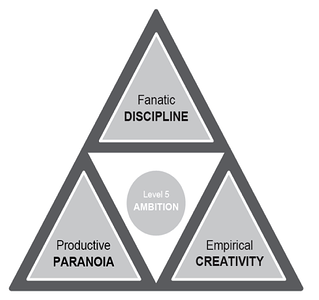
9 Disciplines to Activate Collins’ 20-Mile March
Wed, Jul 25, 2012 — Discipline is Good, Right? In Jim Collins’ “Great By Choice” this pyramid model provides a framework for his trilogy-logical discussion. I’ve read this book wearing two lenses – one, as a principal in our firm, and two as a marketing executive. As a business leader, I aspire to a higher level of discipline in my leadership as well within my personal work ethic. As a marketer, I recognize – primarily from the past 10 years of expanding digitally-dominated marketing and dynamic market ecosystems – that discipline is indeed the capstone of success. Goes Against My Instincts The 20 Mile March is “Jim Collins code” for consistent, methodical and metered execution. He correctly calls it out as a choice or decision, even a strategy, for securing sustained growth. The argument goes against several mantras ingrained within me – “strike while the iron’s hot” “leverage your opportunities” “capture the moment”. No, instead, his research observed that companies win (and south pole explorers survive) when they meter their progress. How might this apply to our business at Chief Outsiders? Perhaps we should add one new major market a year to our firm, regardless of the market conditions. If it’s a tough year, we add one new market. If the economy is rocking and highly favorable, we still add only one new market. Collins’ research tells us the benefits of steady pace outweigh the opportunistic instinct to lunge ahead in good times or hunker down in tough times.