.png?width=1500&height=398&name=CO_Corporate%20Logo%202021_4C_HOR_FNL-1%20(1).png)



Part 4 of the “ABM for Enterprise Value” series
In PE-backed environments, growth alone isn’t enough. What separates your company from those that lose momentum is Net Revenue Retention (NRR). Expansion and renewal dollars are more efficient, more defensible, and more valuation-accretive than chasing new logos.
That’s why the best-performing PE-backed companies run like orchestras: disciplined practice, crisp process, and every section playing from the same score. Monthly cross-functional reviews, SLAs that eliminate hand-off misses, and compensation tied to team outcomes aren’t rituals—they’re what keep your NRR above 105% and valuation multiples climbing.
A quick reminder of why Account-Based Marketing matters: it lands the right customers, expands wallet share, and defends renewals in lockstep with Sales and Customer Success.
When it works, the outcome is clear: sustained NRR of 105%+, stronger exit multiples, and freed-up cash for the next acquisition cycle.
Throughout this blog series, we have talked about how each role in the C-suite has a stake in this expansion story. Keep an eye on these role badges as cues for how Marketing, Sales, Finance, and the CEO connect expansion objectives to enterprise value.
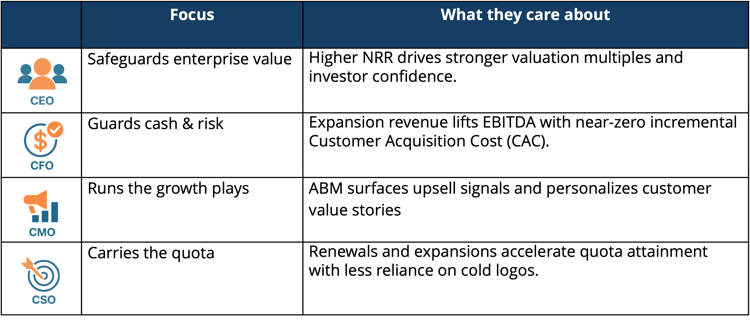
1. Why Expansion Beats Acquisition in a Tight Market
The money math is simple: every dollar of expansion ARR costs less to capture than a new logo.
-
New logo dollars → heavy CAC, longer payback, higher risk.
-
Expansion dollars → faster to land, deepen customer relationships, and raise switching costs.
The numbers tell the story:
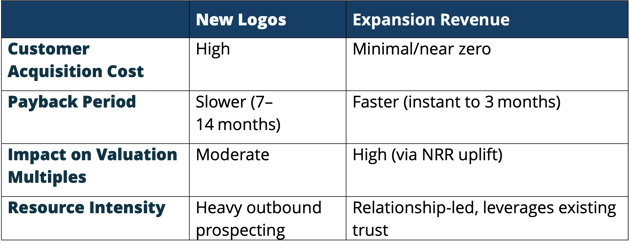
Benchmarkit’s 2025 mid-market SaaS benchmarks confirm that expansion and renewal revenue deliver a faster, more profitable lift than chasing new logos. When capital markets are tight, efficiency isn’t optional - it’s the difference between protecting multiples and watching them erode.
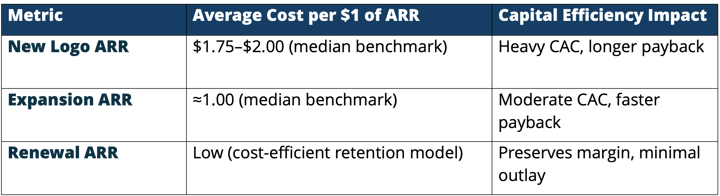
Sources: Benchmarkit 2025 SaaS Metrics, SaaS Capital Retention Benchmarks 2023, RevOps Squared CAC Payback Data 2024
2. The NRR Flywheel: How Growth Compounds
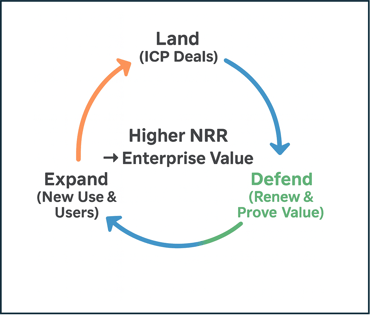
Net Revenue Retention is a growth flywheel. The higher it spins, the faster enterprise value compounds. Net Revenue Retention is a leading indicator of revenue durability for any PE-backed business with repeatable revenue. It shows whether your existing customers grow with you or slowly drift away.
The Land–Expand–Defend cycle isn’t just a sales framework; it’s a valuation engine that feeds itself when every part is tuned to the same goal.
-
Land → Close Ideal Customer Profile (ICP) deals at strong Average Contract Value(s) (ACVs).
-
Expand → Add users, unlock new use cases, cross-sell.
-
Defend → Renew at equal or higher price to validate and reinforce value.
Each turn of the cycle pushes Net Revenue Retention higher, funding the next “Land” motion without incremental Customer Acquisition Cost (CAC).
3. Three Expansion Plays to Consider
Here are three examples of plays for you to build, based on practical triggers your team can act on. Each requires cross-functional execution, with every leader playing a part in protecting and expanding enterprise value.
-
Renewal Shield protects what you’ve earned, keeping revenue secure and price integrity intact.
-
Value Depth grows within existing relationships, turning proven value into a greater share of spend.
-
Footprint Expansion extends that success across sites, divisions, or business units, compounding NRR through scale.
Play 1: Renewal Shield
Trigger: A renewal contract is 120 days out.
When a contract is up for renewal, every role has a part to play in protecting price and strengthening the relationship:
-
CEO sets the guardrails, approving retention terms that protect both price integrity and customer trust.
-
CFO runs scenarios modeling price increases to safeguard margin.
-
CMO sharpens the narrative, framing customer-value realization tailored to the buying committee.
-
CSO leads the conversation, scheduling the Business Review and aligning the executive sponsor.
Impact: Done well, “Renewal Shield” turns what could be a margin-eroding discount cycle into a confidence-building moment that lifts NRR and locks in enterprise value.
Play 2: Value Depth
Trigger: The customer achieves clear results or ROI from your existing solution.
-
CEO reinforces the partnership and approves deeper engagement.
-
CFO confirms that the added scope maintains healthy margins.
-
CMO captures the success as a proof story to fuel credibility.
-
CSO works with the account champion to identify next-layer opportunities: premium tiers, complementary services, or expanded capacity.
Impact: “Value Depth” converts proven value into a greater share of spend within the same relationship, deepening revenue without new-customer CAC.
Play 3: Footprint Expansion
Trigger: A client with multiple sites, plants, or divisions is using your service in only one.
-
CEO positions the account as strategic, and signal commitment.
-
CFO models scale economics.
-
CMO provides proof points from the pilot site that strengthen the narrative
-
CSO engages division heads and map the rollout path.
Impact: “Footprint Expansion” extends ARR predictably, raises switching costs, and compounds NRR.
Discuss how to make these plays relevant to your industry and growth objectives, and run them in sync to build a more predictable growth system.
4. Team Huddle Action
Big shifts start with small, decisive actions. Use a leadership huddle this month to align on one expansion play and the KPI that proves it’s working.
Ask the room: “Which expansion play will give us the biggest NRR lift in the next 90 days: Renewal Shield, Use Case Expand, or Footprint Expansion?”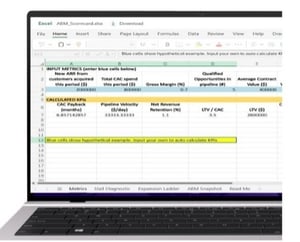
Contact us to request the ABM Value Creation Scorecard to guide your discussion. Inside you’ll find:
-
Metrics Engine: auto-calculate NRR, CAC payback, and LTV/CAC.
-
Stall Diagnostic Heat Map: identify which plays need attention.
-
Expansion Ladder: rank accounts by ARR upside and readiness
ABM for Enterprise Value - The Final Note
Over this four-part series, we’ve seen how Account-Based Marketing, done right, becomes more than a campaign strategy. It can be a revenue engine, a system for enterprise value creation. While many of the examples and benchmarks in the series have been drawn from SaaS, ABM is equally powerful in healthcare, industrial, and business services – indeed, in any industry with a finite TAM (Total Addressable Market), multi-stakeholder buying committees requiring precision plays by persona, and where expansion and retention drive enterprise value faster than chasing unknown accounts.
-
Part 1 showed how orchestration across Marketing, Sales, Finance, and the CEO turns ABM into a growth symphony.
-
Part 2 tackled program stalls and how to revive plateaued pilots before momentum slips.
-
Part 3 highlighted alignment as the score that keeps Sales and Marketing moving in tempo.
-
Part 4 closes with the NRR harmony, where disciplined expansion safeguards cash flow and drives stronger, profitable growth.

Topics: Business Growth Strategy, Value Creation, Private Equity, ABM, Account Based Marketing
.svg)
Related Articles