.png?width=1500&height=398&name=CO_Corporate%20Logo%202021_4C_HOR_FNL-1%20(1).png)

The Contrarian Brand Play: Why Right Now Is the Best Time to Invest in Brand
Part 4 of our four-part series on the evolving AI search landscape and what B2B leaders need to know to stay competitive.

CEOs: Want More Energy? Manage These 5 Buckets
Mon, Sep 22, 2014 — The annual “fill-up” for my leadership bucket comes every August when I attend the Global Leadership Summit – an event that reaches 180,000 leaders around the world. With presentations from amazing leaders – this year including Geoffrey Immelt, Carly Fiorina, Tyler Perry, Patrick Lencioni, plus a number of faith-based CEOs and even pastors – the event covers the gamut for honing leadership skills. Bill Hybels, the man behind this 20-year happening and whose messages are always a highlight, released his new book “Simplify” coincident with the Summit. The premise of the book is this: Leaders who focus on 5 simple areas of their lives will find more clarity and activate more energy to accomplish their God-given purpose on earth. Wow.

Marketing Budget: 7 Benchmarking Questions To Ask
Wed, Sep 3, 2014 — How much do you allocate for a marketing budget? One of the first questions many clients ask is how much to appropriate for a marketing budget. The quick answer for marketing budget allocation is a target of between 3 -8% of a company’s overall sales – with 5% often cited as the norm based upon a review of a range of benchmarking and peer group studies.

Are You Committing Marketing Malpractice? 4 Ways That CEOs Miss the Marketing Mark
Wed, Aug 27, 2014 — A prospective client recently reached out to me, having found me by searching for fractional chief marketing officers on the Internet. This C-suite executive, who shall remain nameless, dispensed with formalities and said, “I am interviewing 15 marketing firms, and I’d like a list of things that we could do for $20,000.” After I took a beat to absorb his “unique” approach, I responded as any ethical Chief Marketing Officer should – calmly explaining that there are many, many steps required before we could even begin to develop a budget to spend those $20,000 hard-earned marketing dollars – things like identifying goals, objectives, priorities and the like.

CEOs: Learn How to Stop Micromanaging
Wed, Jun 11, 2014 — We've probably all had some experience or another with a micromanager, maybe even a micromanaging CEO. But as a CEO, how do you know if you're a micromanager and do you know how to stop? A marketing consultant I know posted on his Facebook page the other day: “Always wonder why some CEOs would rather diddle with things on a web page or other marketing minutia than deal with really important business strategy issues or building a company team.” While I know this was more of an expression of his current frustration with a client than a real question, it got me thinking, and I suspect the answer may be relatively simple: Entrepreneurs stay in startup mode too long.

The One Strategic Marketing Question to Ask
Wed, Jun 4, 2014 — When consulting with businesses, one of the fundamentals I look at is whether their business strategy and marketing efforts are in alignment. Just like a well-aligned vehicle will always move confidently in the right direction, so, too, will a business relationship – provided there’s the right connection between what your customers value, and what you provide. Many times, I will hear companies boast of offering great quality, cost and delivery; how they are innovators; and how they have the best technical support teams. The reality is that it’s quite rare for a firm to be the best at everything – and often, pursuing such a superlative-laden strategy can often be a suboptimal marketing strategy to pursue.

Sales and Marketing: Different or Two Sides of the Same Coin?
Tue, May 6, 2014 — Sales and Marketing: Why Can't We All Get Along? How many times have we all heard about the discord between the Sales and Marketing organizations? This discord intensifies based upon whether you work in a Sales or Marketing driven culture. A CEO recently asked me why these two organizations don’t work well together, and how he can improve their overall relationships, and more importantly their individual and collective effectiveness.

Who Are the Top Business Consulting Firms in Charlotte, NC?
Wed, Apr 30, 2014 — Top Business Consulting Firms Based in Charlotte, NC There are a wide range of consulting firms and business advisory formats available to CEOs and Presidents in Charlotte, North Carolina. As a marketing consultant, I’ve had the opportunity to work with and observe a range of firms, gaining insight into the strengths of various consulting formats.

80% of CEOs Have Lost Trust in Their Marketers
Wed, Feb 19, 2014 — The following blog is Part II to my recent blog Over 70% of CMOs failed to deliver expected real ROI for their efforts in 2013 The breadth of discontent among companies with their marketing begs a further look at the why? How have CMOs become less well regarded than say their IT peers, who have something in the neighborhood of a 50% success rating for their projects? Why is the role of the CMO oftentimes the most precarious in the c-suite? Why are 80% of CEOs unhappy with their marketing talent? The consensus seems to be skill level. While many marketers are strong in one or two or even more areas across the board, strength in both left and right brain functions is rare. And oftentimes, the lure of a good creative can be seductive to a CEO, but at the expense of solid business acumen, disappointment is a sure thing. Few marketers have the finance, technical or operations knowledge to effectively lead business modeling, strategy, and positioning as well as marketing functions such as operations and technology, so instead focus on the ‘softer’ or more tactical aspects of the role.
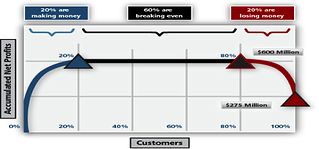
Customers Are Not All Equal
Fri, Feb 14, 2014 — Why it’s important to understand customer value, and what to do about it Every Management Team knows the intricacies of their respective P&L, but can they honestly say they understand the value that each customer delivers to their franchise? More importantly, if they have gone through the hard work of developing a robust customer profitability analysis, have they taken the next step to implementing key business changes based upon the data?(http://www.journalofaccountancy.com/Issues/2008/Dec/ManagingCustomerProfitability.htm) I have worked for some of the leading Fortune 50 companies over my career, where the Leadership Teams actively managed their P&L’s to ensure top and bottom line growth. Not until I was “tapped on the shoulder” to take a senior leadership role in one of our “challenged” businesses, did we even start the discussion about how much each of our customers brought to the bottom line. It was important as we treated every customer the same – meaning, they received superior customer service. Theoretically, we would never consciously bring in unprofitable customers, but the reality was that every customer didn’t bring the same value to the bottom line.