.png?width=1500&height=398&name=CO_Corporate%20Logo%202021_4C_HOR_FNL-1%20(1).png)



|
Great technology is necessary. It is not sufficient. The graveyard of MedTech is lined with brilliant innovations that never found their market — not because of scientific failure, but commercial invisibility. |
I just returned from LSI USA ‘26 in Dana Point — the most impressive gathering of emerging MedTech talent I’ve witnessed in decades. The event convened 2,000 executives, 394 presenting startups, and over 500 active investors and strategics. The scientific ambition in that room was extraordinary.
And yet, when I asked founders in the hallways or during meals about their go-to-market plan, their demand generation strategy, or how they intended to use AI to build commercial traction with a lean team — the answers were frequently vague, underdeveloped, or absent entirely.
This article is a practical toolkit for early-stage MedTech leaders who want to build not just a breakthrough product, but a breakthrough business — one that is funded and structured to win commercially, not just clinically.
The Numbers You Cannot Ignore
Before we discuss what to do, you need to understand what happens when commercial strategy is treated as a post-approval afterthought:
|
74% |
of US-based medical device startups fail to return capital to investors — regardless of clinical merit or regulatory clearance.1 |
|
98% |
of digital health startups fail within two years — the highest failure rate of any technology category.2 |
|
#1 Cause |
of startup failure is “no market demand” — not scientific failure, not regulatory failure. Market.3 |
|
$94M |
average cost to bring a PMA device to market — yet most companies budget almost nothing for commercial infrastructure pre-launch.4 |
What the data tells us is not that MedTech companies build bad products. The failure pattern is commercial. The product reaches the market without a prepared buyer, a mapped sales motion, or a funded demand generation engine. Most MedTech launches fail not because the device lacks clinical merit, but because the commercial strategy underestimates the complexity and the dynamic nature of the buying environment.
The Funding Blind Spot: Raise for Commercial Execution
Here is the conversation I wish every early-stage MedTech company would have 12–18 months before approaching investors: What will it cost to commercialize this product with intentionality?
The commercial gap I observed at LSI ‘26 has two root causes. Either the company hasn’t modeled its commercial costs in enough detail to know what execution requires — and therefore starts building far too late — or they assumed it would be manageable and were surprised by the true investment required. Either way, the result is the same: a cleared device entering the market with insufficient commercial fuel to achieve rapid adoption.
|
The most underfunded line item in early-stage MedTech budgets is intentional commercial execution — the combined investment in demand generation, sales infrastructure, reimbursement navigation, KOL development, and brand building that converts a cleared product into a revenue-generating business. |
When you raise your next round, investors are modeling the probability that your cleared device will generate the returns they need. They want a funded commercial plan that accounts for the real cost of market access, sales rep carry time to productivity, reimbursement consulting, KOL activation, and the 12–18-month runway to meaningful revenue. Companies that build their raise around a fully costed commercial plan consistently reach milestones faster and with less capital distress.
The AI Blind Spot: Building With It, Not Selling With It
AI dominated the conversation at LSI ‘26 — in product development, clinical trial design, surgical robotics, and diagnostics. The technology community has embraced AI as a development accelerator in impressive ways.
What was almost entirely absent: AI as a commercial accelerator. No session addressed how a three-person commercial team can execute the demand generation work that historically required ten people. No one discussed the AI-powered workflows that allow early-stage companies to build market presence, qualify targets, automate outreach, and generate intelligence — all without the headcount costs that have historically forced early commercialization to wait.
What an AI Commercial Operating System Actually Does
For founders wondering where to start: a genuine AI commercial OS is not a collection of tools. It is four integrated capabilities working in sequence.
AI-driven demand generation. Machine learning scores and prioritizes accounts using procedure volume, claims data, and clinical profile matching. Automated outreach sequences are calibrated to specialty, role, and buying stage. A two-person marketing team executes at the velocity of ten.
Commercial intelligence. Real-time monitoring of competitive activity across literature, conference presentations, and regulatory filings. Payer policy tracking. Health system purchasing signal identification. The market intelligence that large strategics have entire teams to produce — now accessible to a startup.
Workflow automation. Automated follow-up sequencing, meeting preparation, post-call documentation, and VAC package generation that reclaims selling time. AI-assisted budget impact models and economic value calculators built before your sales team needs them.
Measurement architecture. The most common failure mode in AI commercial deployment is not knowing whether it is working. A properly built AI OS tracks leading indicators — account penetration rate, outreach response rates, pipeline velocity, time-to-second meeting — not just lagging revenue. This is what separates the 60% of teams generating 2–3× ROI from the 59% who cannot demonstrate any return at all.
Note: according to a survey of 1,400 marketing professionals conducted with Benchmarkit, only 41% of companies can demonstrate AI ROI — down from 49% the prior year. More adoption, less proof. Because tools without architecture do not produce measurable outcomes.
The Commercialization Toolkit: Six Non-Negotiables
Each element below should begin no later than 18 months before your anticipated commercial launch — in parallel with product development, not sequentially after it.
|
1. |
Define Your Commercial Hypothesis Before Your Launch Date |
Most early-stage companies have a rigorous clinical hypothesis. Far fewer have built a commercial hypothesis with equal discipline: a documented, evidence-supported answer to who will buy, who will pay, what they value, and how the decision gets made across every stakeholder layer — clinician, administrator, IDN, and payer.
Investors ask about your GTM plan because they are asking for evidence that you understand the commercial ecosystem your product will enter — and that you have a funded, specific plan to navigate it. Can you explain, in under 90 seconds, who makes the purchase decision, what they need to see before they say yes, what your share gain strategy is and what your cost of customer acquisition will be at scale? If not, your pitch is incomplete regardless of your clinical data.
|
2. |
Build Your Reimbursement Strategy in Year One, Not Year Three |
There is no faster way to stall a MedTech launch than arriving at commercialization with an unclear reimbursement pathway. The US healthcare system does not reward innovation; it rewards documented, covered, billable value. Your reimbursement strategy must identify existing CPT or ICD-10 codes for initial coverage, the gap between that coverage and your target ASP, the evidence plan required for favorable new technology coverage decisions, and a realistic timeline to payer coverage — which often doubles your time-to-revenue estimate.
|
3. |
Develop Your KOL & Advisory Board Strategy Before You Need It |
Clinical champions do not emerge organically at scale. They must be identified, cultivated, and activated as part of a deliberate commercial strategy — and this takes time. Your KOL program should begin during design validation and early access. The clinicians who participate in your first cases are not just safety validators — they are your first commercial advocates if you invest in the relationship correctly.
Map your KOL ecosystem now. Identify the ten clinicians whose endorsement will move markets in your specialty. Build a formal Scientific Advisory Board that can support publication strategy, abstract submissions, conference presence, and regulatory credibility simultaneously. Create advocacy before your commercial launch, not after it. Peer credibility is the single most powerful commercial force in device adoption.
|
4. |
Design Your Sales Architecture for the Resources You Have |
One of the most dangerous mistakes early-stage companies make is designing their commercial model around a future headcount they cannot yet afford. Your initial architecture should be built for constraint: choosing between direct sales, hybrid independent reps, distribution partnerships, or IDN channel strategy based on the capital you have today. Hiring salespeople without goals, without defined messaging/positioning, without a well-defined sales playbook, and without sales enablement tools won’t move the needle. Territory prioritization rigor is essential from Day One. A focused, funded model targeting ten high-probability accounts will consistently outperform an underfunded model spread across one hundred.
|
5. |
Build Your Brand & Conference Presence Before Your Sales Team Arrives |
Your brand is not your logo. It is the positioning your company owns in the mind of every stakeholder who will influence adoption. Before your first commercial rep makes a call, the clinical world should already know who you are. They should have encountered your content in specialty publications, seen your data presented at the major society meeting in your category, and experienced your company as a credible presence in their professional ecosystem.
Conference and congress strategy is a core commercial tool — not a networking expense. Abstract submissions, symposia presentations, KOL podium opportunities, and exhibit floor presence at the right specialty societies are direct demand generation activities. Building this before your sales team arrives means your reps walk into a warmed market rather than spending their first year on pure education.
|
6. |
Raise Capital That Funds Commercial Execution — Not Just the Device |
Your investor pitch is incomplete without a fully costed commercial plan. This means accounting for the real expenses of demand generation programs, sales rep base salary plus 12–18 months of carry time to productivity, reimbursement strategy consulting, KOL activation and publication support, conference presence, Value Analysis Committee tools, digital marketing infrastructure, and the AI-powered commercial tech stack that allows a lean team to execute at scale.
Build your raise around this commercial plan. Know what it costs to execute your GTM strategy with intentionality and fund it explicitly. Investors who see a company that has modeled commercial costs with the same rigor applied to R&D and regulatory will have significantly higher confidence in the investment thesis — and will be far more likely to close.
The MedTech Commercial Plan: 18 Elements Across Three Gears
A commercial plan for a medical device startup is a structured operating blueprint — not a marketing brochure. The framework below adapts the Chief Outsiders Growth Gears® methodology specifically to the early-stage MedTech commercialization environment, incorporating the elements most critical and most frequently underinvested in this sector.
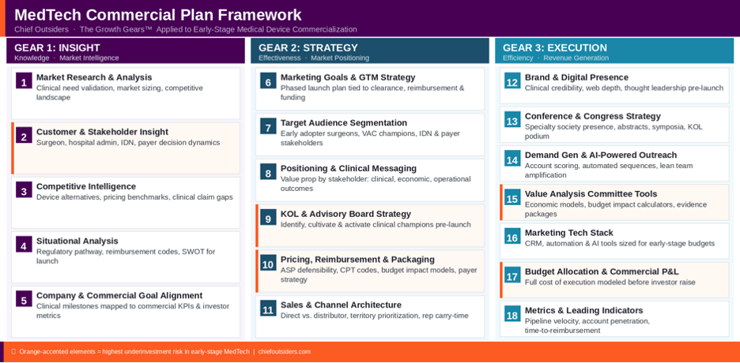
Orange-accented elements in the framework above represent the highest underinvestment risk in early-stage MedTech. Five deserve special attention:
- Customer & Stakeholder Insight (2): Most companies map the clinician but fail to deeply model the IDN administrator, procurement committee, and payer — the stakeholders who control the purchase decision and coverage pathway.
- KOL & Advisory Board Strategy (9): This cannot begin at launch. It requires 18–24 months of cultivation, publication pipeline development, and conference positioning to produce commercial impact on schedule.
- Pricing, Reimbursement & Packaging (10): Your price point must be defensible to Value Analysis Committees, not just clinically compelling. You must justify why your price is reasonable compared to what the current “standard of care” product costs. Build a budget impact model before you set your ASP and build the narrative for why the current standard of care should be replaced by your product.
- Value Analysis Committee Tools (15): VAC packages, economic calculators, and evidence dossiers are commercial infrastructure, not sales support. Build them before your sales team needs them.
- Budget Allocation & Commercial P&L (17): This is the most underbuilt element in early-stage MedTech. Model the full cost of commercial execution — headcount, programs, tools, KOL activation, and reimbursement support — before you raise.
The Broader Context: Where Every Industry is Struggling
The commercial AI gap observed at LSI USA ‘26 is not unique to MedTech. It is the dominant pattern across small and mid-market companies globally — and the research is unambiguous about both the scale of the gap and the cost of not closing it.
The chart below synthesizes five key trends from leading research institutions, with direct implications for early-stage medical device companies.
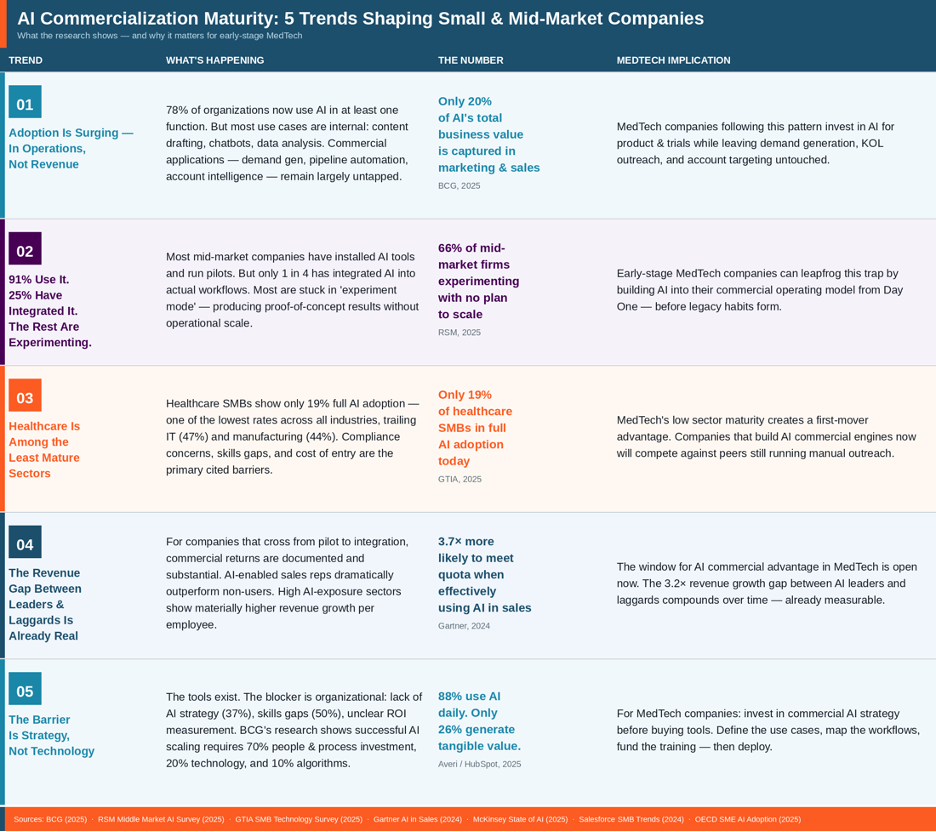
What the research collectively tells us is this: MedTech is not behind the curve — it is on the curve with every other industry. The difference is that in MedTech, the cost of delayed commercialization is measured in funding runway, not just missed quota. And unlike most industries, the MedTech buyer ecosystem — clinicians, hospital administrators, IDNs, payers, and Value Analysis Committees — is complex enough that AI-enabled commercial intelligence is not a luxury. It is a structural requirement for a lean team to compete.
The companies at LSI USA ‘26 are building in a sector where only 19% of healthcare SMBs have reached full AI adoption — which means the first-mover advantage is still very much available. The 3.7x sales quota attainment advantage and 3.2x revenue growth premium enjoyed by AI-mature companies have not yet been competed away in this space. That window will not stay open indefinitely.
The Commercial Imperative
The innovators at LSI USA ‘26 are building technologies that could meaningfully improve patient lives. The scientific rigor and entrepreneurial conviction in that room were genuinely inspiring.
But inspiration does not become impact without commercialization. A device that never reaches patients at scale — however brilliant its mechanism of action — is a scientific achievement without a healthcare outcome.
The companies that will define the next decade of MedTech will be those that build commercial capability as a core competency from the beginning, raise capital that explicitly funds commercial execution, deploy AI not just as a product tool but as a commercial multiplier, and present to investors not just a compelling device — but a credible, funded path from innovation to revenue.
The technology is ready. The market needs are real. Now build the commercial architecture to match the quality of your innovation.
1Focused Ultrasound Foundation, "Why It Takes So Long to Develop a Medical Technology" (2019, updated 2024); Proximo Medical, "Why Do 75% of U.S. Based Medical Device Start-Ups Fail?" Additional corroboration: Embroker startup failure research cited in MassDevice and medtech industry analyses. The 75% figure refers to failure to return investor capital, not company closure.
2Focused Ultrasound Foundation, "The Complex Ecosystem of a Medical Device Startup" (Part 1) and "Why It Takes So Long to Develop a Medical Technology" (Part 14). The 98% figure is specific to digital health startups; broader medtech device startup failure rates are estimated at 75%. Source also corroborated by Twenty Ideas, "The Most Common Reasons Health Tech Startups Fail."
3CB Insights, "The Top Reasons Startups Fail" (annual post-mortem analysis); SBA small business failure data as reported in Forbes; ODT/MPO, "The Fundamentals of Go-To-Market Strategy in Orthopedic Medical Devices" (Shepherd, Medi-Vantage, 2022). Across studies, lack of market need/demand consistently ranks as the #1 reason for startup failure.
4MassDevice / AdvaMed analysis of FDA approval pathway costs; cited in Focused Ultrasound Foundation series. The $94M figure represents average total cost for a PMA (Premarket Approval) pathway device, with approximately $75M attributed to FDA-linked stages. 510(k) pathway average is cited at $31M.
Topics: Business Growth Strategy, CEO Business Strategy, Healthcare, AI, MedTech
/cmo-Denise-Steinbring.jpg?width=200&height=200&name=cmo-Denise-Steinbring.jpg)
Related Articles