.png?width=1500&height=398&name=CO_Corporate%20Logo%202021_4C_HOR_FNL-1%20(1).png)

The Contrarian Brand Play: Why Right Now Is the Best Time to Invest in Brand
Part 4 of our four-part series on the evolving AI search landscape and what B2B leaders need to know to stay competitive.

The Accidental CEO and 5 Steps to Avoid Being the Reluctant CEO
Sun, Oct 28, 2012 — The Age Old Story You were content in life, working to contribute in operations, sales or product/technology development. You were a master, an expert in your field and were comfortable in your skin. Then the business was rocked when the leading family member became seriously ill; or your key partner suddenly seemed to go nuts — focusing on personal enrichment at the expense of the business; or simply sudden CEO succession was needed. It is an age-old story, a company needs a competent new leader — and through no fault or desire of your own, you find yourself playing the central role of the accidental or reluctant CEO. Over the years, I have met countless CEOs who never aspired to the position of business leader. Some took on the three letter title at startup but never really expected to be the leader of a significant, complex and demanding business. Others were suddenly thrust into the role to save the company or replace a previous CEO. Regardless of how it transpired, these CEOs did not aspire, position or groom themselves to lead a business, but they did step up when required.

Business Analytics: Where Do We Go From Here?
Thu, Oct 25, 2012 — Bloomberg Research Services has recently published a report entitled "The Current State of Business Analytics: Where Do We Go From Here?” In this publication several key findings from a survey of 930 global businesses in various industries were highlighted. I found these insights to be particularly useful: Business analytics is still in the “emerging stage.” While business analytics has gone mainstream, most organizations still rely on traditional technology. Spreadsheets are the number-one tool used for business analytics. Organizations are proceeding cautiously in their adoption of analytics. Use of business analytics within companies has grown over the past year, but at a moderate rate. Analytics also tend to be used narrowly within departments or business units, not integrated across the organization. Intuition based on business experience is still the driving factor in decision-making. Analytics is used as part of the decision process at varying levels, depending on the organization. Companies are looking to analytics to solve big issues, with the primary focus on money: reducing costs, improving the bottom line, and managing risks. Data is the number-one challenge in the adoption or use of business analytics. Companies continue to struggle with data accuracy, consistency, and even access. Many organizations lack the proper analytical talent. Businesses that struggle with making good use of analytics often don’t know how to apply the results. Culture plays a critical role in the effective use of business analytics. Companies that have built an “analytics culture” are reaping the benefits of their analytics investments.
5 Steps to Making the Right CRM Decision for Your Business
Wed, Oct 24, 2012 — Today's Guest Blog is by Barret Blank, President and CEO of BB2e
6 Reasons for Marketing Involvement In Supply Chain Management
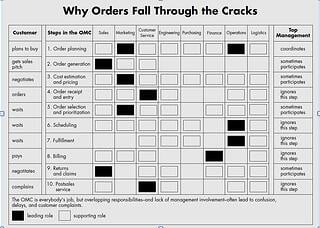
Mon, Oct 22, 2012 — Customer Relationship Management The idea that a company can increase their competitiveness by focusing on how a company interacts with its customers is not new but little has been accomplished to this end across corporate America. In 1992 the Harvard Business Review published a ground-breaking paper called Staple Yourself to an Order. I came across this paper several years after it was written, while I was in an operations and logistics role and it captured my imagination. In essence what the paper was saying is that companies did not have an end-to-end process around customer relationship management. There were no processes in place to manage the customer at every interaction point in a consistent manner. There is a great chart in this document on page 6 entitled "Why Orders Fall through the Cracks" (see below) that really captures the issue and illustrates a typical organizational structure and what happens to a customer going through the entire process of placing an order.

The Power of Yelp: You Can't Ignore It
Thu, Oct 4, 2012 — What do you do when you want to try a new restaurant? Well maybe not you in particular, but many people turn to Yelp. Yelp is a social site where members post reviews of local businesses where they eat, shop and go to for services. And many people read those reviews. In fact, Yahoo News reported that a 1/2 star change in reviews can increase customers in the restaurant by almost 20%.
The Importance of Authentic Service and Hospitality in Business
Tue, Oct 2, 2012 — What Makes Exceptional Service in Your Business? Recently I have been looking more closely at service — which factors contribute to great service in business and which elevate the quality of service to exceptional levels. I have considered both the objective, measurable components of service as well as the subjective — less tangible factors that focus on the specific relationship between those served and those serving. It's fairly simple for us to evaluate the concrete aspects of service. We, as marketers, preach and follow mantras of "what gets measured, gets done," and "if we can't measure it, we can't manage it." We rate and measure service quality with customer satisfaction research and Net Promoter scores. Measurement is, and will continue to be, a critical component of our understanding and responding to day-to-day performance in our businesses. In today's increasingly competitive market though, is evaluating only the easily measured variables sufficient? Is doing this alone enough to raise our customer service from great to exceptional? Does it ensure that our business performance is consistent with our vision, values and strategy?

Business Growth Strategies: Keeping a Stainless Reputation
Thu, Sep 27, 2012 — A Case Study on Sustaining Generational Growth Blickman, a fifty year old family owned business, is a leading manufacturer of high quality stainless steel materials handling and storage equipment for the health care industry. The customers include facility planners for hospitals, outpatient surgery centers, doctor’s offices, laboratories, clinics, and any health industry facility that needs fabricated stainless steel materials handling and storage systems. Blickman is owned and operated by two brothers. One serves as CEO and the other serves as CFO. The company recently invested in creating more capacity and needed help with strategic planning to increase revenue and utilize the additional capacity. The company did not have a CMO and brought in a CMO from Chief Outsiders. Because of the economic downturn, many new healthcare facility construction and expansion projects were unfunded and on hold so the market growth was stagnant. The business was not growing as the owners envisioned, and there was no strategic growth plan or marketing strategy to take advantage of the Blickman brand’s excellent reputation. The market has evolved to an RFQ lowest-bidder-wins environment. Blickman is not the lowest-cost provider and does not want to compromise their quality image by producing inferior quality. Blickman had not done a strategic plan and the focus was on day–to-day operations and opportunities. There were no strategic marketing initiatives.

7 Leadership Insights for CEOs from a U.S. Air Force Major General
Wed, Sep 26, 2012 — “Be the boss you wish you had” is the cornerstone of leadership wisdom that was imparted by US Air Force Major General Garrett Harencak to those attending a recent networking meeting by the Commerce & Industry Association of New Jersey (CIANJ). Major General Garrett Harencak, a highly decorated general, captivated the audience for an hour speaking on a subject he is passionate about: leadership. According to the General, leadership is something that you have to “practice every day”. Admittedly, it is not something that he has fully mastered, although I am sure he is quite accomplished. Leadership is something CEOs, small business owners, or anyone leading a team (in business or otherwise) can always strive to improve upon (including myself).
The New CEO Mandate
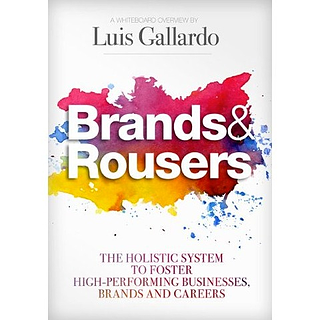
Mon, Sep 17, 2012 — Guest post by Luis Gallardo, Author of Brands & Rousers: The Holistic System to foster High-Performing Businesses, Brands & Careers.