.png?width=1500&height=398&name=CO_Corporate%20Logo%202021_4C_HOR_FNL-1%20(1).png)

Go-To-Market Cultural Alignment: The Invisible Variable in U.S. Expansion
Many companies that find success outside the United States have one thing in common: the need to succeed in the U.S. market.
That is not complicated or surprising. The United States is the largest economy in the world and, in many categories, the single biggest available market. World Bank data clearly shows the scale of the U.S. economy relative to most global markets. For companies in high-tech, scientific, medical, industrial, and systems integration sectors, the U.S. is not just attractive. It is strategic.
Company leaders want to grow. The U.S. is where they look. They are not wrong.

Key Marketing Metrics for Revenue and Profit Growth
Fri, Mar 13, 2015 — Marketing metrics are at the essence of any business program. Key marketing metrics indicate the heights to which revenues will soar or the depths to which fortunes will plummet—as a result of your strategic business efforts.

It’s Inc. 5000 Season – Should You Apply?
Mon, Feb 23, 2015 — What Does It Take to Make the Inc. 5000? To make it in the Inc. 5000 list of America’s fastest growing private companies, a business needs to move from being a scrappy startup to a scaling company. First, the company must simply stay alive 5 years and then hit some revenue minimums to make it on the list. The Inc. growth ranking is based on the last 3 of those 5 years minimum of being in business. The full requirements and application are listed on the Inc. 5000 application site. (Note this year’s deadline is April 30th)

How to Use Predictive Analytics & Lead Scoring to Supercharge Your Sales Funnel
Thu, Feb 5, 2015 — It's time to add predictive analytics and lead scoring to your sales strategy tool belt. As I have discussed in my previous articles, digital marketing tools and technologies are transforming the way businesses connect with prospective and existing customers. Adoption of these technologies is key to maintaining and gaining competitive advantage.

Random Acts of Marketing…Bad for Business
Tue, Feb 3, 2015 — Does your company practice what is sometimes called the “Hope Method” of marketing? That is when you hope you will get new clients, hope people will refer you and hope sales will increase. Most often I see business owners and CEOs practice what I call the “Random Acts of Marketing” method. In executive meetings, the management team laments that the sales team is not meeting expectations. Suddenly the table is filled with marketing experts who begin chanting a litany of marketing ideas (although all too often there isn’t anyone with real marketing expertise in the room). We need a new brochure. Our branding is killing us. The website is tired. Let’s run some advertisements. We need to do social media. Let’s run a sale. We need to do more trade shows. Let’s do some press releases and get an article about us in a trade publication. Then after earnest debate, someone in marketing (or someone posing as marketing) is tasked with one or two of these programs. Voila! You have just witnessed the birth of random acts of marketing. Given that these tactics are born of pain rather than an integrated strategic marketing plan with measurements, they rarely yield profitable outcomes. When CEOs approach me as a CMO consultant, they often tell me they have tried everything to grow their business (and they probably have) but are not seeing the results they expected. They want to know if “I should do more” of whatever the tactic du jour happens to be for them. Being the pragmatist that I am, I usually ask them a series of questions:

The Difference between CEOs who Manage vs. Lead
Tue, Jan 27, 2015 — A long-time client surprised me last week. He called to update me on his pursuit of a new position within his company and, in the course of our conversation, said that his CEO “is an extremely talented manager but not much of a leader.” The assessment itself didn’t surprise me. I have known this CEO for over 30 years and agree completely. What did surprise me was hearing my friend make the distinction. We have often talked about the differences between managing and leading. Like most people, however, he generally uses the terms interchangeably and doesn’t really make a distinction day-to-day—just the kind of thing that drives leadership experts like John Kotter crazy. For over 40 years, Kotter has been on a mission to get people to think about the distinction between management and leadership. Our ongoing transition from a manufacturing-based economy to a service-based economy, however, has made Kotter’s work much more difficult. We still need to understand the difference between management and leadership, but it is increasingly difficult to be an effective CEO without also being a good leader.
How to Best Leverage Marketing Technologies in 2015
Thu, Jan 22, 2015 — I was recently asked my thoughts on how technology and digital trends will shape the future of marketing. As I pondered this question, I took note of all of the ways that I am digitally connected to the outside world. My laptop, smartphone, phablet, tablet, and e-reader were all dripping digital data to some unseen force through my WiFi connection. A fitness tracker awaited the opportunity to observe and report my next activity. Acting as marshals for many of these resources were my modem and router, which collected the needed inputs and outputs and converted my actions into trackable information.
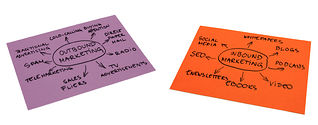
A Recipe for Outbound Marketing Success in an Inbound Marketing World
Thu, Jan 8, 2015 — I had a conversation recently with a business associate who was pronouncing dead the discipline of outbound marketing – which, simply stated, is the technique of reaching out to a prospect proactively to gain their attention and ultimately, their business. This associate went on to say that his recent attempt to send a direct mailer to hundreds of prospects was an abject failure. Hardly any business had resulted from the investment. When I probed as to the reasons for the failed outbound marketing attempt, I learned that this individual conducted no appreciable follow-up, had not developed a plan to reinforce the message in the mailer and had no rhythm, cadence or even schedule for reaching back out. It is often forgotten in this brave new world where inbound marketing – abetted by social media and other relatively easy portals for a prospect to initiate contact with a business – rules the day that the outbound side of the equation, when executed well, can still have a place in many business’s toolkits.

Five Ways to Jazz Up your Content Marketing in 2015
Wed, Jan 7, 2015 — If you are reading this blog right now, you are participating in a trend that has transformed the face of marketing as we know it. “Content marketing is …….. creating and distributing valuable, relevant and consistent content to attract and acquire a clearly defined audience – with the objective of driving profitable customer action,” according to the Content Marketing Institute. If that sounds a lot like what traditional advertising endeavored to do, you’re correct. Content – its creation, refinement and dissemination through multiple channels of communication – has become the essential recipe to the marketing formula. And, like traditional advertising, the gauge of success, too, for content marketing is, “profitable customer action”, e.g., thought leadership, lead generation – and ultimately, sales.

Digital Demand Generation Marketing: Optimize for the Future
Tue, Dec 16, 2014 — Digital Demand Generation: A New Level of Marketing In my last blog, I talked about the need to have your marketing plans be mindful of the increasing importance of marketing technology infrastructure, data, content, mobile and privacy regulations. Assuming you are ready with your new marketing strategies, it’s time to take a deeper dive into the great level of the marketing playing field – digital demand generation marketing. In a little under a decade, the advent of new social and online tools has dramatically changed demand generation – using tools that are accessible, easy to use and offer the ability to micro-target like never before.