.png?width=1500&height=398&name=CO_Corporate%20Logo%202021_4C_HOR_FNL-1%20(1).png)


| Executive Takeaways |
|
The CEO must be the architect and champion of the GTM model — not its operator. |
The 90-Day GTM Transformation Roadmap: Building the GTM Operating Model While Running the Business
By Kelley Marko (CMO) and Neil Isford (CSO), Chief Outsiders
Part 6 of a 6-Part Series on Building a Unified GTM Operating Model to Unlock Scalable Growth
Revenue team misalignment is one of the most significant and misunderstood constraints to growth in scaling companies. While early-stage organizations can often rely on founder-led growth and informal coordination and collaboration across go-to-market (GTM) teams, alignment frequently breaks down as complexity increases. The outcome is often a fractured and unpredictable revenue engine that hinders growth and suppresses company value.
If you've read the first five articles in this series, they outlined the challenges: the informal CEO-led growth model breaks at scale, competing revenue team truths create friction, pipeline leaks sabotage growth, alignment meetings don't fix system design problems, and CEOs must champion the GTM operating model without operating it themselves.
The question then becomes practical: How do you actually build a unified GTM operating model while running the business?
The concern we hear most often from CEOs is this: "It sounds like a massive transformation project. I don't have 12 months for this. I barely have 12 days."
The good news is that building a unified GTM operating model doesn't require months of disruption, expensive consultants, or massive organizational upheaval. With the right approach, you can deliver initial improvements in 30 days and have a functioning operating model in place within 90 days.
This article gives you the high-level blueprint for how to do it.
The Dual-Track Approach: Quick Wins + Sustainable System
In most growth-stage companies, even 90 days can push one’s patience. But here’s why it’s the right approach for this transformation:
- It's long enough to build real infrastructure and change behavior patterns
- It's short enough to maintain urgency and momentum
- It aligns with quarterly planning cycles
The misassumption that most organizations make is that you can’t create a sustainable GTM operating model while still running the business. The good news is there doesn’t need to be an either/or tradeoff between fixing immediate growth gaps and building the scalable infrastructure. The right approach does both simultaneously, delivering quick wins while building the sustainable system.
Think of these as parallel tracks:
Track 1: Generate Quick Wins (Days 1-30)
Track 1 is about identifying and implementing three to five high-impact, low-effort fixes that immediately improve pipeline quality, forecast accuracy, and team alignment. These create momentum, build credibility for the larger effort, and often provide ROI for the entire initiative.
Track 2: Build the Operating Model (Days 1-90)
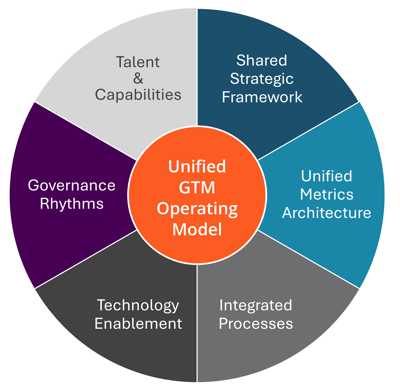
Track 2 designs and installs the six components of the unified GTM operating model we outlined in Blog 4: Strategic Framework, Metrics Architecture, Integrated Processes, Technology Enablement, Governance Rhythms, and Talent & Capabilities.
The quick wins prove the concept. The operating model makes it sustainable.
The Blueprint for the 90-Day Build
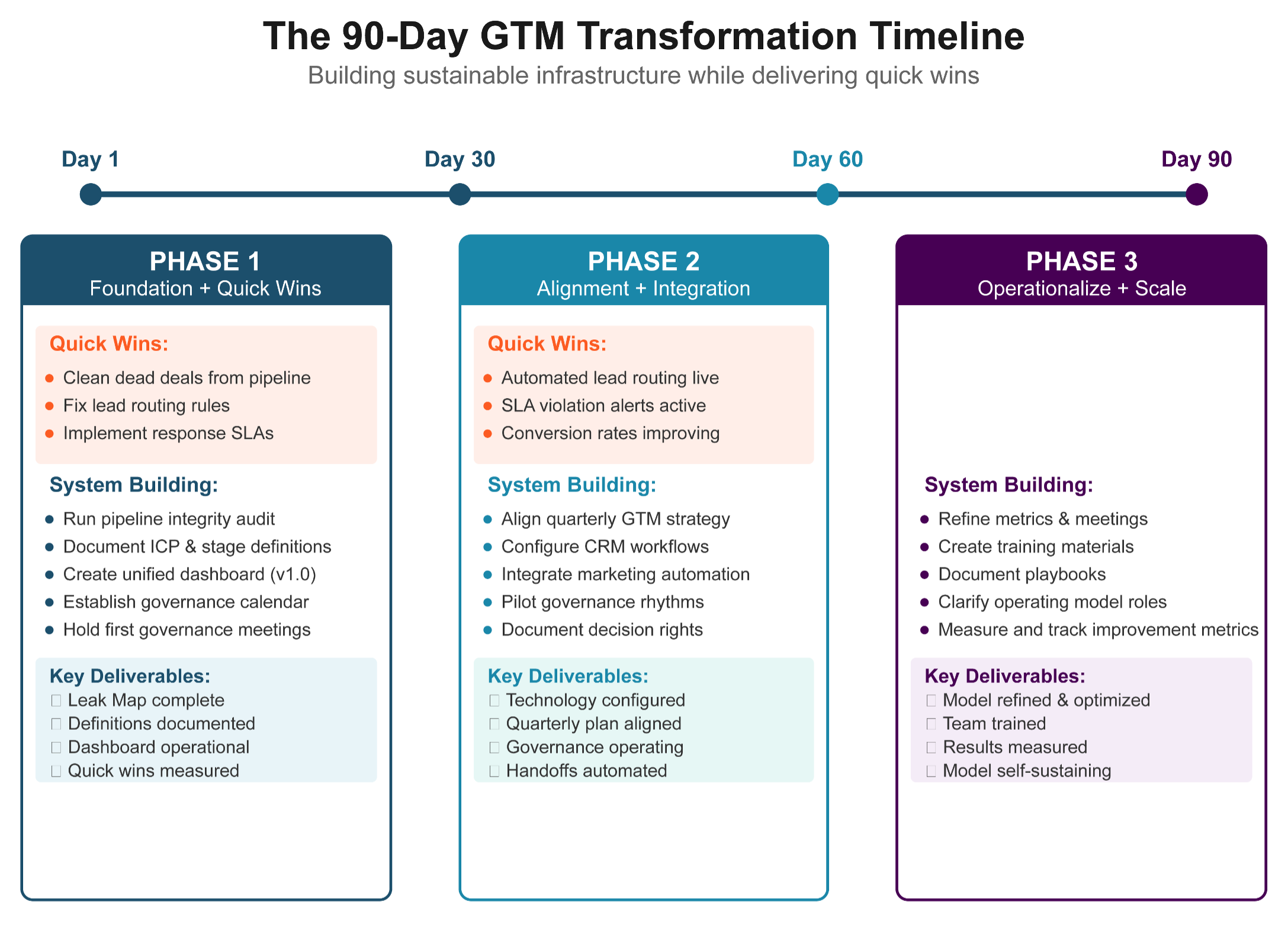
The 90-day transformation breaks into three distinct phases, each building on the last. In Phase 1, you establish the foundation and deliver early proof points. In Phase 2, you integrate the components and pilot the early system. In Phase 3, you operationalize what you've built and demonstrate measurable results. Throughout all three phases, you're running both tracks simultaneously – implementing quick wins that show immediate value while building the structural components that make those improvements permanent. Here's how each phase works. Keep in mind that specifics are typical but illustrative – your quick wins, deliverables, and outcomes will be driven by your unique situation.
Phase 1: Days 1-30 (Foundation + Quick Wins)
The goal in the first 30 days is to run the pipeline integrity audit (from Blog 3), document core definitions, identify quick wins, and establish your governance foundation.
Key Activities:
-
Conduct the 30-day pipeline integrity audit to identify your biggest leaks
-
Select and implement three to five quick wins from the audit
-
Get leadership alignment on ICP, stage definitions, and handoff SLAs
-
Set up your unified dashboard (even if imperfect, you'll refine it later)
-
Install the governance meeting rhythm (weekly/monthly/quarterly)
Deliverables by Day 30:
-
Documented ICP and stage definitions
-
Leak Map showing top pipeline issues
-
Unified dashboard (v1.0)
-
Governance calendar established
-
Three to five quick wins implemented and measurable
At the end of the first 30 days, Sales and Marketing will be using the same definitions for the first time, your forecast will have a documented methodology, and you can see the same data everyone else sees.
As the CEO, your role is to sponsor the audit, participate in ICP and definition working sessions, approve the dashboard design and governance structure, and champion the quick wins. Let your team do the rest.
Phase 2: Days 31-60 (Alignment + Integration)
In the next 30 days, the focus moves to aligning strategy across functions, configuring technology to enforce the model, and piloting the governance rhythms.
Key Activities:
-
Conduct joint quarterly planning with Sales, Marketing, and Customer Success leaders
-
Align on shared goals, success metrics, and resource allocation
-
Document decision rights (who owns what decisions)
-
Configure CRM workflows to match stage definitions
-
Build automation for handoffs and SLA tracking
-
Run your first four weekly pipeline reviews using the new definitions
-
Hold your first Monthly GTM Operating Review
Deliverables by Day 60:
-
Aligned quarterly GTM plan with shared metrics
-
CRM and marketing automation configured to enforce process
-
Decision rights documented
-
Governance meetings running (four weekly, one monthly completed)
-
Lessons learned document: what's working, what needs adjustment
After 60 days, your technology stack enforces your definitions instead of allowing drift, handoff failures surface automatically through SLA tracking, and leaders make decisions within the framework instead of escalating to you.
You should attend the Monthly GTM Operating Reviews, resolve any strategic disagreements that emerge, and approve technology investments. The changes will stick when you model the behaviors; reference the dashboard, use ICP language.
Phase 3: Days 61-90 (Operationalize + Scale)
The next 30 days are about fine tuning your system based on learning, building sustainability, and demonstrating measurable progress.
Key Activities:
-
Adjust meeting cadences and agendas based on what's useful versus overhead
-
Remove metrics that don't drive decisions; add missing ones
-
Document playbooks for common GTM scenarios
-
Clarify/solidify roles within the GTM operating model
-
Train new hires on the operating model
-
Measure and track improvement metrics
-
Share the impact of the new GTM operating model (internal, Board)
Deliverables by Day 90:
-
Refined operating model based on real usage
-
Training materials and playbooks
-
Progress documented and shared internally and with the Board (forecast accuracy, conversion improvements, CEO time freed)
-
System roles understood and operating
By the end of 90 days, the model feels like "how we work" rather than "the new thing we're trying." New hires learn it in their first weeks. Strategy meetings and Board presentations now focus on growth instead of variance explanations. You should notice your shift in role from operator to owner of the system.
Review progress metrics, hold leaders accountable to the system, and communicate wins to the board. Resist the urge to jump back into operations when something doesn't work perfectly – revisit, refine, and let the system mature.
What Success Looks Like at 90 Days
At the 90-day mark, you should start to see noticeable qualitative shifts and measurable quantitative improvements. While your exact experience will vary based on where you started from, here are some benchmarks you can use to help assess your transformation success and ROI:
Quantitative Improvements:
-
Conversion rates up 5-10% at 1-2 key funnel stages
-
Forecast accuracy improved by 10-15 percent
-
CEO time spent on GTM related issues reduced by up to 50%
Qualitative Shifts:
-
Sales and Marketing reference the same ICP in every conversation
-
Less debate over lead quality
-
Handoffs work because definitions and SLAs exist and systems enforce them
-
Pipeline reviews focus on exceptions, not explanations
-
New team members understand "how we go to market" within their first two weeks
-
SLT and Board conversations lead with strategy, not variance storytelling
Cultural Transformation:
From "Whose fault is it?” and “We need another alignment meeting," to "Let's check where we’ve drifted from the operating model and course correct.”
The Right-Sizing Principle: Managing Complexity
As you get started on your 90-day transformation, it’s important not to overbuild enterprise-grade complexity into your GTM operating model. While the fundamentals and roadmap for the model hold true across company size, what you need operationally for a $10M scaling organization is not the same as a $100M+ one. Below are some quick tips for where to focus, based on what we typically see for companies at various stages of scale:
For $10-25M companies:
-
Focus on: Clear ICP, basic stage definitions and roles, simple unified dashboard/tracking, governance rhythm
-
Skip: Complex tech stacks, elaborate CRM workflows, multiple sub-stages
For $25-100M companies:
-
Add: Handoff SLAs, integrated systems, segmented pipeline tracking
-
Technology stack grows and starts enforcing process, not just tracking it
For $100M+ companies:
-
Full model: All six components, sophisticated analytics, AI-enabled tools, comprehensive governance
-
The infrastructure justifies the investment
Start where you are and add sophistication as you scale.
The Path Forward
Over the past six articles we've taken you from diagnosis to solution, giving you all the tools you need to move from a friction-filled, CEO-dependent growth model to a unified GTM operating model that scales. A model where alignment is automatic, pipeline integrity is the default, and your revenue engine behaves predictably quarter after quarter.
If you've recognized the symptoms we've described throughout this series - forecast misses, pipeline leaks, alignment meetings that change nothing, your time consumed by internal mediation - you already know the informal model isn't working. The question becomes when and how to get started to change it.
Our upcoming eBook Building a Unified GTM Operating Model to Unlock Scalable Growth will help you get started. Or contact us to learn about our structured, 60-day GTM Operating Model Transformation that includes:
-
Assessment of your GTM approach across Sales, Marketing and Customer Success
-
Design of a unified GTM model with ICP, metrics, process, systems, and governance
-
A clear 90-day roadmap for your GTM transformation
-
Guided roadmap activation
You’ll walk away with a gap analysis, unified GTM operating model, a 90-day roadmap, and hands-on support to activate your transformation.
About the Authors
/Kelley-Marko.jpg?width=275&height=275&name=Kelley-Marko.jpg) |
/Neil-Isford.jpg?width=275&height=275&name=Neil-Isford.jpg) |
|
Kelley Marko Kelley Marko is a CMO at Chief Outsiders, where she helps growth-stage companies build unified go-to-market operating models and scalable marketing functions. |
Neil Isford Neil Isford is a CSO at Chief Outsiders, specializing in building high-performance sales teams for PE-backed and founder-led organizations. |
Catch up on the full series
-
Pipeline Integrity: How Hidden Revenue Leaks Sabotage Growth
-
Stop Hosting Alignment Meetings and Start Building a Unified GTM Operating Model
-
The CEO's Role as Champion of the Unified GTM Operating Model
-
The 90-Day GTM Transformation Roadmap: Building the GTM Operating Model While Running the Business

Topics: Business Leadership and Strategy, Alignment, Business Growth Strategy, Strategy
.svg)
Related Articles