.png?width=1500&height=398&name=CO_Corporate%20Logo%202021_4C_HOR_FNL-1%20(1).png)

The Contrarian Brand Play: Why Right Now Is the Best Time to Invest in Brand
Part 4 of our four-part series on the evolving AI search landscape and what B2B leaders need to know to stay competitive.

Start Using Market Research Strategies to Drive Your Company’s Growth
Sat, Aug 24, 2013 — Market Research Strategies: Getting to Your Company to The Next Level Quite often these days, especially evident in mid-market businesses, I come across CEOs, who have been very successful at building their company’s revenues but are now are challenged with reaching the next level. Sales may have slowed down; the low hanging fruit picked; or competitors are upping their game. They may also have been successful in using their technology and expertise in one market, but totally misread another. Whatever the issues are; in order to flourish, every company should consider integrating market research strategies into their growth plan to keep a pulse on their market and its dynamics and to capitalize on market opportunities. Growing through market research strategies can include new products and services, new pricing plans, new positioning, new market segments, changes in business models, or new channels of distribution. Each of these should be evaluated, researched and integrated into your growth strategy and ultimately into your business, product development, and tactical go-to-market plans.

Great CEOs “Eat a Frog First Thing Every Day”
Wed, Aug 7, 2013 — “If you eat a frog first thing in the morning that will probably be the worst thing you do all day.” – Mark Twain. Mark Twain truly had a way with words. Most of us have read at least one of his 28 books. Much has been written about his famous “eat the frog first” quotation including articles that question whether he actually said or wrote this. Regardless of the truth, the analogy is intended to help great leaders tackle more difficult, dreaded and distasteful actions first everyday. There are some business coaches that don’t agree with doing the most unpleasant work first, but they all agree that successful business leaders are great at prioritizing their activities every day.

Marketing Budget: How much should a CEO spend?
Wed, Jul 17, 2013 — How much sould a CEO spend on a marketing budget? Whether or not it is the first question asked, it is usually one of the first questions a CEO thinks about when discussing his or her marketing efforts: how much should I spend on a marketing budget? Well, the average company spent 10.4% of its revenue on marketing in 2012. And according to Gartner, that marketing budget is scheduled to go up by 6% in 2013. Now this includes salaries of the marketing people, but it doesn’t include things like software licenses or servers for the data. And this spend widely varies for the types of companies from IT at 3.5% to over 12% for media companies.

D.A.R.E. to Grow
Wed, Feb 20, 2013 — Sometimes it is difficult for our organizations to take the steps necessary to grow – to change – to leave what is comfortable and strive for something more. We stop ourselves with questions like: How will my organization adapt to the changes? Can we handle the new challenges? Do we have the skills required to meet the new demands? Why should we upset what is already going well? It makes perfect sense for us to question. In fact, we wouldn’t be doing our jobs as leaders if we didn’t. At some point though, if we want to move forward, we must also move beyond the questions. We must take our own dare, if you will – and D.A.R.E. to grow. Here are some thoughts to get us started. D = Discover
![Market-Driven Strategy Doubles Annual Revenue for ISTN [CASE STUDY]](https://www.chiefoutsiders.com/hs-fs/file-14389357-jpg/images/business-strategy.jpg?width=320&name=business-strategy.jpg)
Market-Driven Strategy Doubles Annual Revenue for ISTN [CASE STUDY]
Tue, Dec 11, 2012 — In this case study, see how a market-driven strategy helped a business consolidate sales and marketing programs, increase revenue growth, and expand into new geographic markets. As a management buy-out company of a Westinghouse division, IST produced instrumentation and optics used in the nuclear power, defense, safety and spectrophotometer markets.
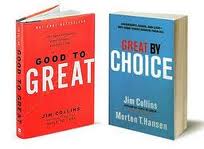
Jim Collins' Great By Choice: SMaC Develops Your "Brand"
Tue, Jul 17, 2012 — What we can learn from Jim Collins' Great By Choice I’m a huge Jim Collins fan (and look forward to seeing him at the Global Leadership Summit Aug 9/10). But I will admit that I haven’t read all of his books cover to cover. You know, you pull a few cool ideas then lose interest once the nuggets have been revealed. That was until Jim Collins' “Great By Choice." I couldn’t put this one down and I couldn’t get enough. Perhaps it’s having the perspective from his prior findings, models and perspectives to build upon. But I found “Great By Choice” to be Jim’s best and most practical piece yet. In summary, I found that this wonderful book shares simple, actionable truths applicable to businesses of all sizes. Use SMaC to Develop Your Brand - Practices Can Last Decades Like many, I use a Kindle and enjoy highlighting and making notes as I go. Then I go back and review the “greatest hits” to be sure I’m activating the concepts I had hoped to retain. Having just done that, I was again taken by the SMaC (Specific, Methodical and Consistent) model and approach with this summary: “A solid SMaC recipe is the operating code for turning strategic concepts into reality, a set of practices more enduring than mere tactics. Tactics change from situation to situation, whereas SMaC practices can last for decades and apply across a wide range of circumstances.” - Jim Collins' “Great By Choice” Chapter 6 Struck by the phrase “practices can last for decades,” because it’s perhaps an unspoken truth that the 10X (winning) companies build their reputations (their brands) by executing consistently, over time. Collins’ references to company recipes and even the U.S. Constitution Articles that don’t change from year to year, but may evolve with highly considered amendments, is a reminder of knowing what you stand for. In our firm, we find this so important we’ve made it a centerpiece of our approach with clients, specifically our Purpose-Driven Marketing. With a business’ purpose in place – a purpose that reflects their knowledge of the marketplace – one can make plans, decisions and take actions with a consistency that other companies can’t.
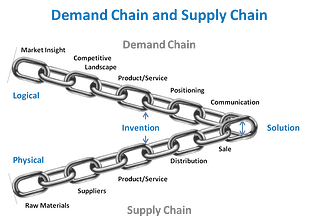
Growth Opportunity: The Demand Chain
Mon, Mar 19, 2012 — Efficiency Only Goes So Far The last ten years of American business have been focused on integrating and perfecting operational efficiencies through the perfection and active management of the Supply Chain. For the last couple of years of economic turmoil, many companies have almost exclusively focused on supply chain efficiencies as a strategy for survival. Now the challenge is taking the expertise and company culture focused on linear thinking and introspection of the supply chain and start growing again.

3 Top Sources of Strategic Marketing Insights
Mon, Jul 18, 2011 — Effective marketing strategies that drive significant results are almost always based on key insights. Insights can come from a lot of different places – from research, from a review of operations, from an analysis of the market, from a review of available data, from experience. The critical common element to game-changing insights is perspective – looking at the situation from a customer/prospect/market point of view. Let’s look at some examples: 1. Research-based Insight At Northeast Savings, we conducted a major customer segmentation study to better understand the needs of our consumers. One of the key findings of the research was a hierarchy of concerns expressed by a key constituency – 50+ consumers. Their number one issue was their health; followed closely by their financial well being, especially as it related to being able to take care of themselves should anything happen to them physically. This insight, coupled with an understanding of the need for conservative investments (in this case, CDs) due to the risk profile of older people, led to the creation of the “Take Ten” CD. This was a traditional CD, earning market interest rates, with a twist – you could withdraw up to 10% of your principal without penalty. Northeast Savings was the first bank in the country to offer this type of CD and was recognized in USA Today. More importantly, the CD garnered $180M in new deposits in the first three months and, after a year, no one had exercised the option to withdraw principal. Consumers wanted the security of knowing that they could, but really needed to earn interest on their deposits.
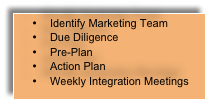
Building Company Value After an Acquisition
Sun, Mar 27, 2011 — Marketing’s Role in Post-Merger Integration The deal was just signed! Now what do we do? How many times have we heard this familiar cry? You are not alone. Over 70% of the deals completed today fail to add company value! The primary reason for most failures: poor post-merger integration planning and execution. The integration of two businesses after an acquisition is no longer restricted to the domain of Finance and IT. Markets drive our businesses today! The role of Marketing in building company value after an acquisition is more critical than ever before. To build market share, competitive dominance and product superiority, Marketing’s approach to the integration program must be very systematic. Marketing must uphold the brand, maintain customer confidence and leverage all possible synergies while vigilantly monitoring ROI. As if this isn’t a difficult enough balancing act, Marketing must articulate the longer-term “go-to-market” strategy to ensure the continuity of value enhancement programs long after the integration process is complete. So where do you begin?